
Data Analyst Career Path: Skills, Salary, and How to Break In (2026)
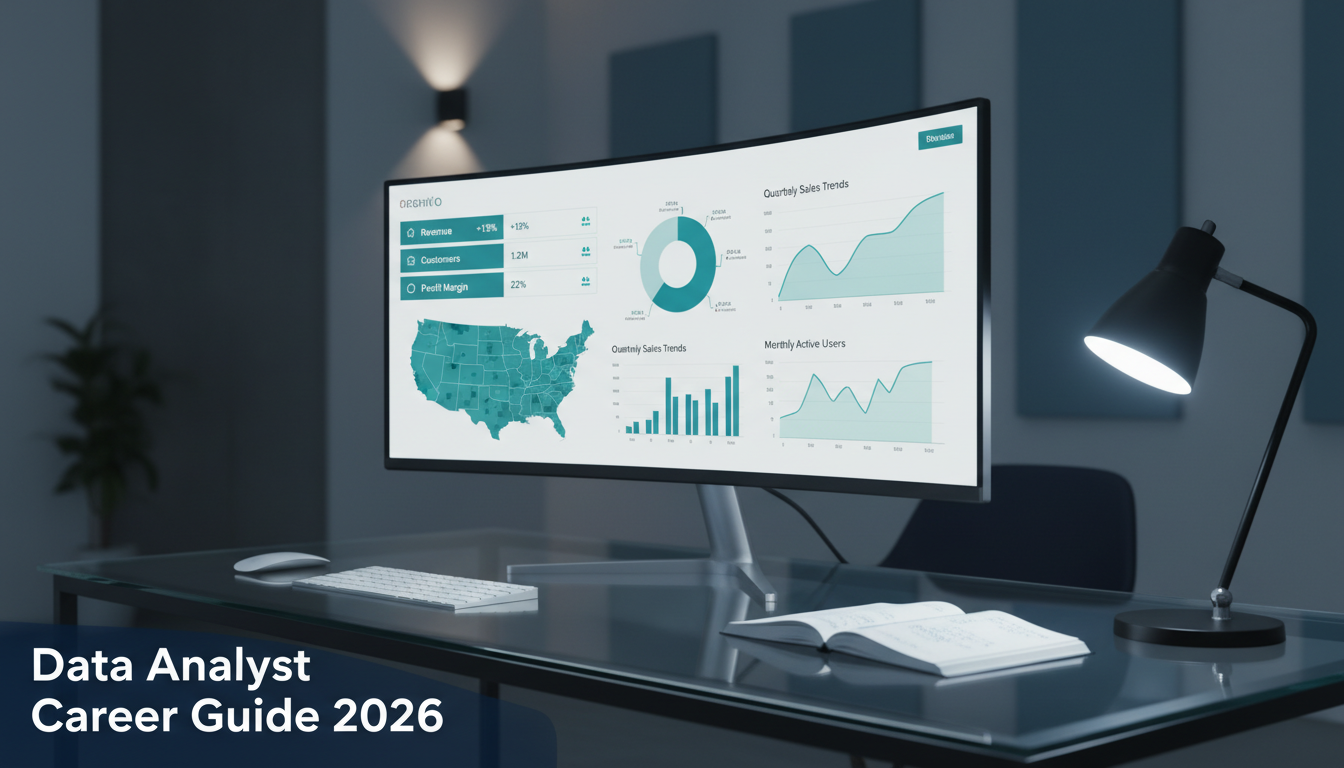
Data Analyst Career Path: Skills, Salary, and How to Break In (2026)
The demand for data analysts has never been higher — and neither has the opportunity for career changers to break in without a traditional computer science degree. If you've been wondering whether data analytics is the right move, here's the short answer: the data analyst career path is one of the most accessible, high-paying pivots available in 2026, with job growth projected between 25–36% through 2033.
This guide covers everything you need to make an informed decision and take action — core skills, realistic salary progression, the certifications worth your time, how to build a portfolio from scratch, and where to find remote roles.
Before diving in, if you haven't already set clear career goals for what you want from this career shift, do that first. The roadmap below becomes far more effective when you know what outcome you're optimizing for.
What Does a Data Analyst Actually Do?
A data analyst collects, cleans, interprets, and communicates data to help organizations make better decisions. Depending on the industry and company size, that can mean:
Writing SQL queries to pull sales or operational data from databases
Building dashboards in Tableau or Power BI that non-technical stakeholders actually use
Cleaning messy datasets in Python or Excel before analysis
Presenting findings to leadership with clear, actionable recommendations
Collaborating with product, marketing, or finance teams to define what to measure
The role sits at the intersection of technical skill and communication. You don't need to be a software engineer — but you do need to think in systems and tell stories with numbers.
Data Analyst Skills in 2026: What Employers Actually Want

The Core Technical Stack
Based on job listing patterns, these are the skills that appear most frequently in data analyst postings:
SQL is the single most listed skill for data analyst roles. If you learn nothing else first, learn SQL. It's the language of data — you'll use it to query databases in virtually every industry.
Python is the second most critical tool, particularly for data cleaning, automation, and more advanced analysis. Libraries like pandas, numpy, and matplotlib cover the majority of day-to-day analytical work.
Excel and Google Sheets remain essential, especially in smaller companies and finance-adjacent roles. Pivot tables, VLOOKUP/XLOOKUP, and basic modeling are non-negotiable baseline skills.
Tableau and Power BI are the dominant visualization platforms. Most job postings list one or both. Power BI is more common in enterprise/Microsoft-stack environments; Tableau shows up more in tech and marketing analytics roles.
Emerging Skills That Differentiate You
AI-assisted analysis — knowing how to use tools like ChatGPT, Claude, or Copilot to accelerate data work is becoming a visible differentiator
dbt (data build tool) — increasingly listed in mid-to-senior roles involving data pipelines
Statistical thinking — A/B testing, regression basics, and knowing when correlation isn't causation
Data storytelling — translating analysis into slide decks and executive summaries
Soft Skills That Close the Gap
Companies don't just hire technical competency — they hire analysts who can communicate findings to non-technical stakeholders, manage competing requests, and push back when a question is being asked incorrectly. Curiosity, structured thinking, and clear written communication consistently show up in hiring manager feedback as differentiators.
Building deep work habits that accelerate skill acquisition will help you stack these skills faster than the average self-taught learner.
Data Analyst Salary Progression: What to Expect at Each Stage
Here's how compensation typically progresses on the data analyst career path:
Level | Experience | Salary Range |
|---|---|---|
Entry-Level | 0–2 years | $55,000–$65,000 |
Mid-Level | 3–5 years | $75,000–$90,000 |
Senior | 5+ years | $95,000–$120,000+ |
A few important nuances:
Industry matters significantly. Finance, tech, and healthcare analytics roles consistently pay above the median. Nonprofit and government roles often land below it.
Location premium is shrinking — but still real. Remote work has compressed the gap between San Francisco-based and mid-market salaries, but major metro listings still trend 10–20% higher on average.
Specialization accelerates salary growth. Analysts who develop expertise in a specific domain — marketing analytics, product analytics, financial modeling, healthcare data — move into higher compensation bands faster than generalists.
Ready to see what's actually out there? Browse open Data & Analytics roles to benchmark real-world postings against these ranges.

The Best Certifications for Data Analysts in 2026
Certifications won't replace a portfolio or real experience, but they do two things well: they give you a structured learning path and they signal credibility on a resume before you have work history in the field.
Google Data Analytics Professional Certificate
Platform: Coursera Duration: ~6 months at 10 hours/week Cost: ~$200–$300 (subscription-based)
This is the most widely recognized entry-level certification in the field, covering SQL, R, spreadsheets, and Tableau. It's practical, well-structured, and hiring managers at major companies actively look for it. For career changers, this is the default starting point.
IBM Data Analyst Professional Certificate
Platform: Coursera Duration: ~3–5 months Cost: Similar to Google's
The IBM certificate goes deeper into Python and data visualization than the Google cert. It's a strong complement — or alternative — particularly if you want to emphasize Python over R. IBM's brand carries weight in enterprise hiring contexts.
Additional Credentials Worth Considering
Microsoft Power BI Data Analyst (PL-300) — valuable if you're targeting enterprise/finance roles
Tableau Desktop Specialist — recognized directly by hiring managers in marketing and analytics-heavy industries
DataCamp Data Analyst track — not a formal cert, but the project-based learning translates well to portfolio work
Tip: Don't certify your way into paralysis. One solid certification plus a portfolio of 3–5 real projects will beat five certificates with no demonstrated output.
How to Build a Portfolio That Gets You Hired
A portfolio is the single highest-leverage investment a career changer can make. It transforms you from "someone who completed a course" to "someone who can do the work."
What to Include
3–5 end-to-end projects, each demonstrating a different skill or domain:
SQL + analysis project — take a public dataset (Kaggle, data.gov, or Google BigQuery public datasets), ask a real business question, write queries to answer it, and document your findings in a GitHub README
Python data cleaning project — find a messy dataset and clean it with pandas, documenting your decisions and the before/after state
Dashboard project — build a Tableau Public or Power BI dashboard using publicly available data (sales trends, COVID data, sports stats) and publish it with commentary
Domain-specific project — pick the industry you're targeting and build something relevant (e.g., e-commerce funnel analysis for retail roles, churn analysis for SaaS)
Where to Host It
GitHub for code, notebooks, and SQL files — include a clear README for every project
Tableau Public for dashboards — free to publish and shows up in portfolio links
Personal site or LinkedIn to tie everything together with context and narrative
What to Avoid
Don't just complete the tutorial datasets that came with your course. Hiring managers see hundreds of "Titanic survival analysis" projects. Use real-world data from a domain you find genuinely interesting — your curiosity will show in the depth of your analysis.
Breaking In: Entry Points for Career Changers
If you're pivoting from another field, you have more leverage than you think. The key is identifying adjacent roles that build credibility while you develop your analytical skills.
Adjacent Entry Points
Reporting Analyst / Business Analyst — these roles emphasize Excel, basic SQL, and communicating insights, with less emphasis on Python. They're easier to land first and position you for a lateral move into data analysis.
Data Analyst Intern / Junior Analyst — some companies (especially mid-size tech and e-commerce) explicitly hire career changers through structured junior programs. These roles pay less but build real project experience quickly.
Industry-specific analytics roles — if you come from marketing, finance, HR, or operations, there are analyst roles within those functions (marketing analyst, financial analyst, workforce analyst) that let you combine domain expertise with emerging data skills.
The 90-Day Plan for Career Changers
Days 1–30: Complete the Google Data Analytics Certificate. Simultaneously, practice SQL daily on Mode Analytics or SQLZoo.
Days 31–60: Build your first two portfolio projects. Set up GitHub. Start connecting with analysts on LinkedIn in your target industry.
Days 61–90: Apply to 10–15 roles per week. Focus on roles labeled "entry-level" or "junior." Customize your resume headline and summary for each application batch.
If you're still evaluating whether this is the right direction, this piece on choosing a career path and sticking to it will help you stress-test your commitment before you invest the time.
Where to Find Data Analyst Jobs in 2026
Job Boards and Strategies That Work
LinkedIn remains the strongest platform for data roles, particularly because recruiter outreach is high and "Easy Apply" reduces friction. Set alerts for "data analyst" + your target location or "remote."
Indeed captures a broader range of company sizes, including mid-market and small business roles that often don't post on LinkedIn.
Specialized job boards like Dice (tech-focused), Built In (startup-focused), and Glassdoor (strong on salary transparency) are worth checking weekly.
For aggregated listings, explore Analyst job listings — there are currently over 1,215 Analyst postings and 1,784 Data & Analytics roles indexed, spanning entry-level through senior positions.
AI-Powered Job Search
The way people search for jobs has shifted meaningfully in 2026. AI tools now help candidates identify which roles to prioritize, tailor resumes to specific job descriptions, and even practice interview questions. Understanding how to job search in the AI era gives you a structural advantage over candidates still using 2020-era strategies.
Remote Data Analyst Jobs
Remote analyst roles are genuinely available — not just for senior hires. Companies that rely heavily on data (SaaS, e-commerce, fintech, media) have normalized remote analytics work because the output is measurable.
To find them effectively:
Filter for "Remote" on LinkedIn and Indeed explicitly — don't assume hybrid postings include true remote
Look at companies headquartered outside your metro area — they're more likely to be remote-native
Check remote Data & Analytics positions filtered by location flexibility
Note: Entry-level remote roles are more competitive than on-site equivalents. Having a strong portfolio is especially important when you can't make a first impression in person.
Career Progression: Where the Data Analyst Career Path Leads
Data analytics isn't a dead-end role — it's a launching pad. Here's how the path typically forks after your first 2–3 years:
Senior Data Analyst — deeper technical ownership, mentoring junior analysts, leading projects end-to-end. Salary range: $95K–$120K+.
Analytics Manager / Team Lead — managing a team of analysts, setting priorities, interfacing with leadership. Requires stronger communication and project management skills than pure technical ability.
Data Scientist — requires stronger statistical foundations and machine learning knowledge. Python skills from your analyst role transfer directly; the gap is usually statistics and ML frameworks.
Data Engineer — pivots toward building the infrastructure that analysts rely on (pipelines, data warehouses, ETL processes). Requires stronger software engineering fundamentals. For those interested in that trajectory, software engineering roles offer useful context on adjacent compensation and skill requirements.
Business Intelligence (BI) Developer — specializes in dashboard infrastructure, semantic layers, and data modeling. A natural path for analysts who love the visualization side.
The common thread across all these paths: the data analyst career path is a foundation, not a ceiling.
What It Takes to Succeed: An Honest Assessment
Data analytics is a strong career choice in 2026. The job market is real, the skills are learnable, and the compensation is competitive. But it's also worth being clear-eyed about what the role actually demands:
You will spend more time cleaning messy data than doing exciting analysis — probably 60–70% of your time at first
Stakeholder management is a real part of the job; purely technical people often struggle with the communication demands
The field is evolving fast — AI tools are changing how analysts work, and staying current requires deliberate upkeep
None of these are reasons not to pursue it. They're reasons to go in prepared.
Conclusion: Your Next Step on the Data Analyst Career Path
The data analyst career path in 2026 is well-defined, well-compensated, and more accessible than most people assume. With a focused 3–6 month learning sprint, a portfolio of real projects, and a strategic job search, career changers are landing analyst roles every day — without CS degrees and without years of experience.
Start with SQL. Build something you're proud of. Apply before you feel ready.
The data is on your side.
Frequently Asked Questions
What does a data analyst do on a daily basis?
What skills do I need to become a data analyst in 2024?
How much do data analysts make?
Can I become a data analyst without a computer science degree?
Is data analysis a good career choice for 2024?
Related Posts

AI + Careers Briefing — October 13, 2026

AI + Careers Briefing — October 12, 2026