
How to Choose a Career Path (And Actually Stick to It)
How to Choose a Career Path (And Actually Stick to It)
It is 11 PM on a Tuesday. You have 14 browser tabs open: three job boards, a Reddit thread about whether marketing is a dying field, a YouTube video titled "Day in the Life of a Data Analyst," a salary comparison tool, and a half-finished personality quiz that was supposed to tell you what you were born to do. You close the laptop, go to bed, and wake up tomorrow no closer to a decision than you were last month.
If that sounds familiar, you are not alone. A 2024 survey by the National Association of Colleges and Employers found that 61% of recent graduates reported feeling "uncertain or very uncertain" about their career direction within 18 months of finishing school. Among mid-career professionals considering a pivot, the number climbs to 73%.
Career indecision is not a character flaw. It is a structural problem. Most advice tells you what to choose but skips the harder part: how to commit once you have chosen. This guide gives you a repeatable, evidence-based system for figuring out how to choose a career path -- and the tools to stop second-guessing yourself once you do.
Why Career Indecision Feels Impossible to Escape
Research from Glassdoor consistently shows that job dissatisfaction and uncertainty peak among workers in their first two years. But the root cause is not a lack of ambition or talent. It is a collision of three forces that modern professionals face simultaneously.
1. The Paradox of Choice. Psychologist Barry Schwartz demonstrated in his landmark 2004 research that increasing the number of options does not make people happier -- it paralyzes them. When every career path is theoretically accessible through online courses, bootcamps, and remote work, the decision space becomes overwhelming. You are not choosing between three options. You are choosing between three hundred.
2. Social comparison at scale. LinkedIn and social media create a constant highlight reel of other people's career trajectories. You see the friend who pivoted to product management and landed at Google, the classmate who started a startup at 24, the influencer who "found their passion" and never looked back. What you do not see: the years of doubt, the false starts, the quiet pivots behind the scenes. This comparison distortion makes your own uncertainty feel uniquely broken.
3. The sunk-cost trap. If you have already invested years in a degree, a certification, or a role, walking away feels like admitting failure. So you stay in limbo -- not fully committed to the current path, not willing to leave it either.
The result? Constant job-hopping, half-committed side hustles, and a nagging sense that everyone else has figured it out except you.
The real problem is not a lack of options. It is a lack of a decision framework.
The five steps below give you that framework. They are drawn from career development research, behavioral psychology, and practical strategies used by career coaches who work with professionals at every stage.
Step 1: Start with Ikigai (But Use It Correctly)
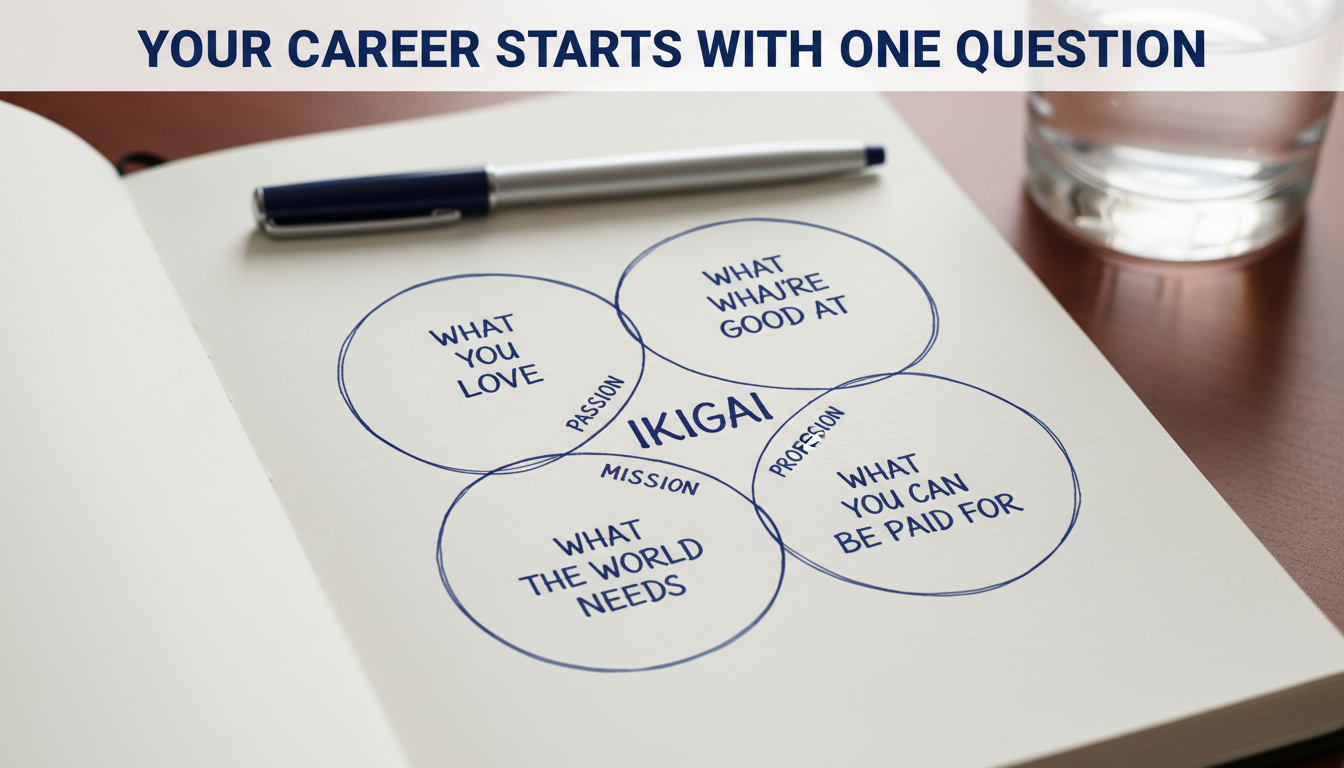
Ikigai is a Japanese concept rooted in Okinawan culture. The word translates roughly to "reason for being" -- the thing that gets you out of bed in the morning. In career contexts, it has been popularized as a Venn diagram with four overlapping circles:
- What you love
- What you are good at
- What the world needs
- What you can be paid for
Your career sweet spot lives where all four intersect.
The catch: most people treat Ikigai as a brainstorming exercise, list a few vague answers, and move on. To use Ikigai career planning effectively, you need specificity -- and you need to push past your first instinct.
Do this instead -- the Specificity Drill:
For each circle, write at least 5 concrete answers. Not "I like helping people" but "I like explaining complex ideas in simple terms to confused customers." Not "I am good at communication" but "I can take a 30-page report and turn it into a 5-minute executive summary that drives decisions." The more specific your inputs, the more useful your output.
Here is a practical example of how the four circles might look for someone considering a career in UX research:
| Circle | Vague Answer | Specific Answer | |--------|-------------|-----------------| | Love | Talking to people | Conducting structured interviews to uncover motivations people cannot articulate on their own | | Good At | Problem solving | Synthesizing 20+ qualitative data points into three actionable product recommendations | | World Needs | Better technology | Products that do not frustrate users over 60 who are navigating healthcare portals | | Paid For | Tech jobs | UX research roles at mid-size health tech companies (median salary: $105K, BLS 2025) |
Then look for patterns across all four circles. If "data analysis," "pattern recognition," and "making systems more efficient" keep appearing, that is a signal worth investigating further.
Tip: Revisit your Ikigai every 6 months. Your answers at 22 will look different at 27 -- and that is a feature, not a bug. Career psychologist Dr. Herminia Ibarra at London Business School calls this "working identity" -- the idea that your professional self is always in progress, not a fixed destination.
Step 2: Run a Skills Inventory
Ikigai tells you what direction feels meaningful. A skills inventory tells you what direction is realistic -- and where your fastest path to traction lies.
O\*NET OnLine (onetonline.org) is a free, government-backed database that maps skills to hundreds of occupations. Maintained by the U.S. Department of Labor, it contains detailed profiles for over 1,000 occupations including required skills, typical education, salary ranges, and projected job growth. You can search by skill, by interest, or by keyword -- and see exactly what competencies each career requires.
Here is how to use it for career direction clarity:
- List your top 10 skills (include both hard and soft skills -- do not undersell the soft ones).
- Run an O\*NET Skills Search using your strongest 3-5.
- Review the occupation matches and flag any that intersect with your Ikigai output.
- Cross-reference salary data and job growth projections to reality-check feasibility.
Building Your Decision Matrix:
Once you have 5-8 candidate careers from your Ikigai and O\*NET overlap, score each one across five dimensions on a 1-5 scale:
| Criteria | Weight | Career A | Career B | Career C | |----------|--------|----------|----------|----------| | Ikigai alignment | 30% | ? | ? | ? | | Skill match (today) | 25% | ? | ? | ? | | Earning potential (5-year) | 20% | ? | ? | ? | | Job market demand | 15% | ? | ? | ? | | Ramp-up time to entry | 10% | ? | ? | ? |
Multiply each score by the weight, sum the columns, and your top two or three careers will surface. This is not about finding a mathematically perfect answer. It is about replacing gut-feeling paralysis with structured thinking that you can defend to yourself at 2 AM when the doubt creeps in.
This process cuts through the noise. Instead of asking "what career should I choose?" you are asking "which careers already value what I bring?" -- a much more answerable question.
Note: Do not disqualify yourself from careers with skill gaps. O\*NET also shows you what you would need to learn, which gives you a roadmap, not a rejection. A 2023 LinkedIn Workplace Learning Report found that 89% of L&D professionals agree that proactively building skills helps navigate an uncertain future -- the gap between where you are and where you need to be is data, not a dealbreaker.
Step 3: Narrow to One Direction (and Commit to Testing It)
Here is where most frameworks fall apart: they help you explore but not decide.
Harvard Business Review has written extensively on how high-achievers approach uncertainty -- and the consistent finding is that the best decisions are made iteratively, not perfectly. You do not need certainty before committing. You need a commitment horizon.
Stanford professor and design thinking pioneer Bill Burnett puts it this way: "You can't think your way into your career. You have to prototype it." His research at the Stanford Life Design Lab shows that people who run small, low-risk career experiments make better long-term decisions than people who try to plan everything from their desk.
The 12-Month Commitment Framework:
- Choose one direction from your Ikigai/O\*NET overlap. Not the perfect one -- the most interesting one with the clearest path forward.
- Set a 12-month window. Commit to pursuing this direction seriously for one year before evaluating.
- Define your success metrics upfront: What would growth look like in 12 months? A new role, a new skill, a project portfolio, a salary jump?
- Close the tabs. Deliberately stop researching other options. Exploration mode and execution mode cannot coexist.
This framework reframes the decision: you are not choosing a career for life. You are choosing an experiment to run with full commitment.
Why 12 months? Research on habit formation and skill acquisition suggests that meaningful competence in a new domain takes 6-12 months of deliberate practice (Ericsson, 2016). Anything shorter does not give you enough data to evaluate the path fairly. Anything longer risks keeping you in a direction that genuinely does not fit.
Avoiding career indecision is not about eliminating doubt -- it is about containing it. Doubt gets 15 minutes on Sunday evenings. The rest of the week belongs to execution.
Step 4: Build a "Stick to It" Support System
The hardest part of choosing a career path is not the choice. It is the moment -- around month 3 or 4 -- when progress feels slow and a different path starts looking shiny again. Psychologists call this the "dip," and Seth Godin wrote an entire book about it: the predictable trough of discomfort that separates beginners from people who actually get good at something.
Almost everyone hits the dip. The difference between people who build careers and people who restart every six months is not talent or luck. It is having a support system that carries them through the dip before they can see the other side.
Prepare for this moment before it arrives:
- Write down your reasons. When you choose your direction, document exactly why. Be specific: "I chose product management because it combines my analytical skills with my interest in user behavior, the median salary exceeds $120K within 5 years, and the role exists at companies I admire." Future-you will need to read this letter on the bad days.
- Find one accountability partner. Someone who will ask "how is the career plan going?" and not let you change the subject. Research from the American Society of Training and Development found that people who have a specific accountability appointment with someone are 95% more likely to achieve a goal than those who merely decide to act.
- Track leading indicators, not just outcomes. Landing a new job might take 12 months. But completing a course, getting a mentor, or shipping a portfolio project can happen in 30 days. Track those. Progress on leading indicators is what keeps motivation alive during the dip.
- Schedule a formal review at month 6. Not to quit -- to assess and adjust. There is a difference between quitting and course-correcting. Quitting is abandoning a direction because it got uncomfortable. Course-correcting is using data to refine your approach while keeping the same destination.
Common pitfalls that derail commitment:
| Pitfall | What It Looks Like | The Fix | |---------|-------------------|---------| | Shiny Object Syndrome | "Maybe I should try data science instead..." (month 2) | Re-read your reasons document. Add new ideas to a "next experiment" list -- do not act on them now. | | Impostor Syndrome | "Everyone in this field is smarter than me" | Track your skill growth monthly. Compare yourself to where YOU were 90 days ago, not to someone with 10 years of experience. | | Premature Optimization | Spending weeks choosing the "right" course/bootcamp instead of starting | Apply the 70% rule: if an option is 70% right, go. You will learn more by doing than by researching. | | Isolation | Grinding alone without community or feedback | Join one professional community (Slack group, meetup, Discord). Participation, not lurking. |
For deeper work on staying productive and purposeful while you build toward your goal, our Career Focus 101 guide covers the broader framework for staying on track in your early career.
Step 5: Turn Your Decision into Goals
Choosing a career path is step one. Once you have committed, the next move is translating that direction into concrete milestones that create forward momentum.
The gap between "I want to work in product management" and actually landing a PM role is bridged by specificity. Break your 12-month commitment into quarterly milestones:
- Months 1-3: Foundation. Complete one core course or certification. Read the three most recommended books in the field. Connect with five professionals already in the role. Ship one small project that demonstrates relevant skills.
- Months 4-6: Credibility. Build a portfolio piece or case study. Attend one industry event or conference. Start writing or sharing about what you are learning -- this builds your professional identity and attracts opportunities.
- Months 7-9: Positioning. Update your resume and LinkedIn with your new direction front and center. Start applying or having conversations about transitional roles. Get one informational interview per week.
- Months 10-12: Execution. Pursue target roles aggressively. Leverage your network, portfolio, and six months of visible momentum. Evaluate your progress against the success metrics you defined in Step 3.
Setting career goals the right way -- specific, time-bound, and tied to your 12-month framework -- is what separates people who drift from people who build. Our post on "How to Set Career Goals That Don't Suck" walks through exactly how to do this without falling into the vague-goals trap.
What to Do When You Want to Quit
This section exists because every honest career guide needs one. At some point during your 12-month commitment, you will want to abandon the plan. That is normal. Here is how to handle it without making a reactive decision you will regret.
Ask yourself these three diagnostic questions:
- "Am I uncomfortable because I am growing, or because this is genuinely wrong?" Growth feels like struggle with a direction -- you are bad at something but getting better. Wrong feels like dread with no signal of progress despite consistent effort.
- "Have I given this enough time to generate real data?" If you are in month 2, you almost certainly have not. The minimum viable evaluation period is 6 months of genuine effort.
- "What specifically would I change if I started over?" If your answer is "everything," that is worth exploring. If your answer is "I would pick a different specialization within the same field," that is a course correction, not a quit.
If after your 6-month review you have clear evidence that the direction is wrong -- not just uncomfortable, but fundamentally misaligned with your values, skills, or market reality -- then pivot with confidence. Add what you learned to your Ikigai, update your decision matrix, and start your next 12-month experiment. You have not failed. You have eliminated a path and gained skills that transfer.
The professionals who build remarkable careers are not the ones who chose perfectly the first time. They are the ones who committed long enough to learn something real, evaluated honestly, and iterated.
The Bottom Line
The path to career direction clarity is not about finding the perfect answer before you move. It is about building a system that lets you move, learn, and adjust without losing momentum.
Here is your starting action: Open O\*NET today, run a skills search with your top 5 skills, and write down three occupations that show up in your Ikigai overlap. Then build a quick decision matrix. That is it. Two hours of structured thinking will get you further than another month of anxious browsing.
You already have more clarity than you think. The framework above -- Ikigai for direction, O\*NET for validation, the decision matrix for prioritization, the 12-month commitment for execution, and the support system for endurance -- gives you the structure to act on it.
The only wrong move is no move at all.
Frequently Asked Questions
How do I know if I chose the wrong career path?
What is Ikigai and how can it help me choose a career?
How can I figure out what careers match my current skills?
How long should I commit to a career path before changing it?
Should I avoid careers where I don't have all the required skills?
Related Posts

AI + Careers Briefing — October 13, 2026

AI + Careers Briefing — October 12, 2026