
The AI Skills Salary Premium in 2026: What 1 Billion Job Postings Reveal
The AI Skills Salary Premium in 2026: What 1 Billion Job Postings Reveal
The AI skills salary premium is no longer one number — it's two, and they're moving for different reasons. PwC's 2026 Global AI Jobs Barometer, which analyzed more than 1 billion job ads across 27 countries, puts the average wage premium for AI-skilled workers at 62%, up from 57% a year earlier. Lightcast's separate analysis of 1.3 billion postings puts the cross-role average closer to 28% (about $18,000 a year).
Both are real. They measure different things. And underneath either headline sits a sharper story: the market is splitting into a fast lane and a slow lane, and which lane you're in depends far more on seniority and function than on whether "AI" appears on your resume at all.
Quick Answer: AI skills carry a 62% average wage premium in 2026 per PwC's Global AI Jobs Barometer (up from 57% in 2025), while Lightcast's separate 1.3-billion-posting analysis puts the cross-role average at 28% (~$18,000/year). The premium is highest in the consumer-markets industry (118%) and lowest in government and the public sector (16%), and it's lowest by far for entry-level software engineers, where it fell from 10.7% to 6.2% in a year. Stacking two or more AI skills earns 43% versus 28% for one, and non-tech functions — HR, marketing, finance — are now growing AI hiring faster than tech itself.
Last verified: September 2026. Every figure below is sourced individually — see the source notes throughout.
Headline Numbers (For Citation)
- 62% AI skills wage premium across more than 1 billion job ads in 27 countries — PwC, 2026 Global AI Jobs Barometer, up from 57% in 2025.
- 28% AI skills salary premium (~$18,000/year) across 1.3 billion job postings — Lightcast, Beyond the Buzz, July 2025.
- AI wage premium ranges from 118% (consumer markets) to 16% (government and public sector) across the industries PwC tracks — PwC, 2026 Global AI Jobs Barometer.
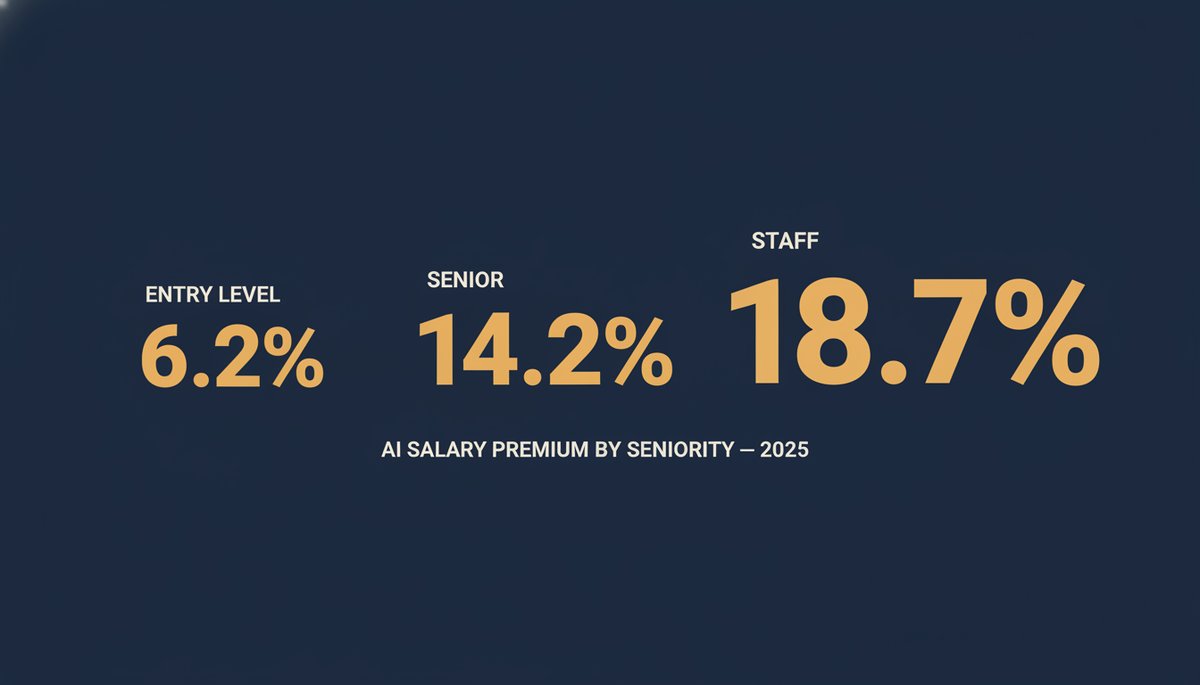
- 6.2% premium for entry-level software engineers (down from 10.7% in 2024) versus 18.7% for Staff engineers (up from 15.8%) — Levels.fyi, Q3 2025.
- 23% UK AI skills premium in peer-reviewed research covering 10+ million UK vacancies — Oxford Internet Institute, Technological Forecasting and Social Change, 2025. That beats the UK master's-degree premium (13%) and trails the PhD premium (33%).
Methodology
"AI skills salary premium" means the wage difference between job postings or workers requiring AI, machine learning, or generative-AI skills and otherwise-similar postings or roles without them — not the absolute salary of AI specialists. We're measuring how much more a role pays because AI skills are attached to it.
This dataset draws on:
- Primary government data — U.S. BLS Occupational Employment and Wage Statistics, May 2025 reference period (released May 2026, roughly six weeks later than usual because of the October–November 2025 federal shutdown): Software Developers $135,980, Data Scientists $120,230, Financial and Investment Analysts $102,740, Marketing Managers $166,790 (national medians).
- Peer-reviewed research — Oxford Internet Institute, published in Technological Forecasting and Social Change (10+ million UK vacancies, 2018 through mid-2024).
- Large-scale postings analysis — PwC's 2026 Global AI Jobs Barometer (1B+ job ads, 27 countries) and Lightcast's Beyond the Buzz (1.3B postings, July 2025).
- Verified-offer data — Levels.fyi AI Engineer Compensation Trends, Q3 2025.
- Industry salary guides — Robert Half's 2026 Salary Guide, a same-source AI/ML Engineer vs. Software Engineer comparison.
- Executive surveys — KPMG's AI Quarterly Pulse Survey, fielded February–March 2026 (237 U.S. C-suite leaders at $1B+ revenue firms).
- Startup compensation data — Carta, January 2024–June 2025.
- Platform hiring data — LinkedIn's 2026 Labor Market Report, cited in Microsoft's 2026 Work Trend Index.
All figures are normalized to USD where applicable. Where PwC (62%) and Lightcast (28%) diverge, that's methodology, not error: PwC compares AI-specific postings against a broad multi-country baseline across every industry and role it tracks; Lightcast compares postings within the same occupation, with an AI skill listed versus not. We name the source for every figure so you can weigh it yourself.
How Much More Do AI Skills Pay in 2026?
AI skills carry a 62% average wage premium in 2026, according to PwC's Global AI Jobs Barometer — its broadest analysis yet, covering more than 1 billion job ads across 27 countries and six continents. That's up from 57% a year earlier. Lightcast's separate analysis of 1.3 billion postings, using a narrower same-occupation comparison, puts the cross-role average closer to 28%, or about $18,000 more per year.
Use PwC's 62% as the "how fast is the AI skills market growing" headline, and Lightcast's 28% as the more conservative estimate of how much adding an AI skill to your own resume might move your posted salary within your current occupation.
Demand is outrunning even the wage numbers. AI-skill job postings are growing 69% year over year — nearly eight times faster than the 9% growth rate for the overall jobs market, per PwC. Indeed Hiring Lab's January 2026 update found a similar pattern inside tech specifically: postings mentioning AI ran about 45% above pre-pandemic (February 2020) levels even as total tech postings stayed 34% below that same baseline.
Which AI Skills Pay the Most in 2026?
AI skills pay the most where hiring has moved furthest outside traditional tech roles, and where the industry itself has moved furthest on AI adoption. Lightcast's analysis of 1.3 billion postings found 51% of AI-skill job listings now sit outside IT and computer science entirely, with 800% growth in generative-AI roles in non-tech industries since ChatGPT's 2022 launch. Growth by sector: HR/talent acquisition +66% year over year (the fastest-growing function tracked), marketing/PR +50%, and finance +40%.
The premium also swings enormously by industry — from 118% in consumer markets down to 16% in government and the public sector, according to PwC's 2026 Global AI Jobs Barometer. That spread matters more than any single average: which industry you're in shapes your AI premium as much as whether you have AI skills at all. PwC's barometer breaks its wage-premium results down by sector — not by internal corporate function like sales, finance, or HR — so we don't cite a PwC-sourced function-level premium anywhere in this piece.
To ground this in real dollars, here's Lightcast's cross-role average applied to current U.S. median pay:
| Role (BLS occupation) | Median base pay, May 2025 | Premium applied | Modeled pay with AI skills |
|---|---|---|---|
| Marketing Manager | $166,790 | 28% (any AI skill, cross-role avg., Lightcast 2025) | ~$213,490 |
| Financial & Investment Analyst | $102,740 | 28% (any AI skill, cross-role avg., Lightcast 2025) | ~$131,510 |
| Software Developer | $135,980 | 28% (any AI skill, cross-role avg., Lightcast 2025) | ~$174,050 |
| Data Scientist | $120,230 | 28% (any AI skill, cross-role avg., Lightcast 2025) | ~$153,890 |
Base pay: BLS Occupational Employment and Wage Statistics, May 2025 reference period (released May 2026). The right-hand column applies Lightcast's single cross-role premium figure to BLS's real median wage for illustration — it is not a directly measured "with AI skills" salary for that exact title. Treat it as illustrative, not exact.
Does stacking multiple AI skills pay more than one?
Yes, and by a wide margin. A single AI skill commands a 28% premium across postings; two or more AI skills together command 43%, according to Lightcast. That 15-point jump is larger than the gap between many entire role categories.
The practical takeaway: "should I learn LLMs or MLOps?" is the wrong question. Lightcast's highest-value clusters are LLM specialization (fine-tuning, prompt engineering, deployment), MLOps, NLP, and applied ML/data analysis — and pairing any two compounds your premium more than mastering one. Mapping this into a mid-year career check-in framework, the actionable move for most professionals is a credible second AI skill that complements what you already do, not a hunt for the single "right" one.
Is the AI Salary Premium Shrinking?
It's doing both at once, depending on where you're standing. PwC's cross-role average keeps climbing — 57% to 62% in a single year — but that headline hides a split market. Levels.fyi's verified-offer data at large tech employers shows the AI premium moving in opposite directions by seniority:
- Entry-level: 10.7% (2024) → 6.2% (2025) — nearly halved
- Engineer: 11.9% (2025)
- Senior: 14.3% (2024) → 14.2% (2025) — essentially flat
- Staff: 15.8% (2024) → 18.7% (2025) — still expanding
PwC's 2026 barometer offers a structural explanation for the split: a "two-track" labor market. "Professionalised" roles — where AI automates routine tasks and human judgment or expertise becomes more valuable (senior engineers, recruiters using AI tools, radiologists) — are growing twice as fast in job availability and delivering 42% faster salary growth than "democratised" roles, where AI makes the work accessible to less experienced workers.
Entry-level hiring shows the same pattern from another angle. Among more than 2.4 million U.S. entry-level job postings PwC analyzed, roles most exposed to AI are now seven times more likely to require traditionally senior-level skills like judgment and leadership — and those AI-exposed entry-level roles grew 35% since 2019, while other entry-level roles declined 10% over the same period. Entry-level work isn't vanishing; it's being redefined to demand skills that used to arrive only with years of experience.
There's also a gap between what employers say they'll pay and what postings actually offer. KPMG's AI Quarterly Pulse Survey (fielded February–March 2026; 237 U.S. C-suite leaders at $1B+ revenue companies) found only 45% of executives willing to pay 11–15% more for AI-capable talent. That sits well below the 28–62% premiums actually showing up in postings — employer expectations haven't fully caught up to the market they're competing in.
Do AI Skills Pay More Than a College Degree?
In the UK, where the most rigorous peer-reviewed data exists, yes. Oxford Internet Institute researchers, publishing in Technological Forecasting and Social Change, analyzed more than 10 million UK job vacancies from 2018 through mid-2024 using regression-controlled methodology — the most methodologically rigorous dataset in this analysis, even though it's UK-only.
Their findings: AI skills carry a 23% wage premium generally, rising to 36% in science, engineering, and tech roles specifically. For comparison, a UK master's degree carries a 13% wage premium and a PhD carries 33%. In pure wage terms, listing AI skills is worth more than a master's degree and approaches a PhD — one of the clearest "is upskilling worth it" answers in this dataset, because it's the one study here with peer review and statistical controls for confounders like occupation and experience.
What Do AI/ML Engineers Actually Earn in 2026?
Robert Half's 2026 Salary Guide — a same-source, apples-to-apples comparison — puts AI/ML Engineer pay at $134,000 (25th percentile) to $193,250 (75th percentile), with a $170,750 midpoint. A general Software Engineer's midpoint sits at $142,000 ($109,250–$175,500 range) — a $28,750, or 20.2%, gap at the same firm. AI, ML, and data-science roles are seeing 4.1% starting-salary growth in 2026, the highest of any technology specialty Robert Half tracks.
That same-title gap widens further with seniority. Levels.fyi's big-tech data shows AI-skilled engineers earning 6.2% more at entry level, 11.9% more as a mid-level Engineer, 14.2% more as Senior, and 18.7% more at Staff — the premium compounds as you're promoted, not just at the point of hire.
Startup pay is moving too, just more slowly. Carta's compensation data across its startup customer base shows AI/ML engineer median salaries growing 5.4% to 9.1% between January 2024 and June 2025, fastest at the smallest, earliest-stage companies. Equity grants for AI/ML engineers have grown faster still over the same window, though secondary coverage of Carta's data cites inconsistent exact percentages for that specific figure, so we're not repeating an unverified number here.
Demand underneath these numbers keeps expanding: employers have created at least 1.3 million AI-related job opportunities in the past two years — including AI engineers, data annotators, and "forward-deployed engineer" roles — according to LinkedIn's 2026 Labor Market Report, cited in Microsoft's 2026 Work Trend Index.
What This Means for Your Career
If you're entry-level
The 6.2% entry-level AI premium (down from 10.7% a year earlier) means one thing: don't bet your job search on the AI label alone. Recruiters now see hundreds of new-grad resumes listing AI/ML coursework, so it no longer differentiates you — and PwC's data shows AI-exposed entry-level roles increasingly expect senior-level judgment on day one anyway. What still works is provable depth in one narrow AI domain — a shipped project, a model you fine-tuned end-to-end, a deployment you maintained — plus strong fundamentals. The tech layoffs job-search playbook covers the tactical side of standing out in a crowded entry-level market.
If you're mid-career
The AI premium is highest where hiring has shifted furthest outside pure tech roles — HR, marketing, and finance are all growing AI-skill demand faster than engineering, per Lightcast. The clearest leverage move is stacking a second AI skill — two-plus skills command 43% versus 28% for one, per Lightcast. If you're in software specifically, remote software engineering jobs in 2026 keep rewarding AI/ML depth most heavily at Senior and Staff levels, where Levels.fyi shows the premium still expanding. Sharpening your fundamentals matters too — technical interview preparation in 2026 covers how that depth actually gets tested now.
If you're non-tech
Your function is very likely already on the premium list. The fastest-growing AI hiring sectors are HR (+66% year over year), marketing/PR (+50%), and finance (+40%) — not engineering, per Lightcast. The path forward isn't "switch into tech" — it's adding AI literacy to the function you're already in. For analysts specifically, the data analyst career path breaks down which AI-adjacent skills are worth prioritizing.
If you're recalibrating which skills deserve your time this year, the companion piece on AI-proof career skills for 2026 covers the durability question this post doesn't: which skills hold up if AI capability keeps advancing.
What the Data Doesn't Say
A few caveats matter as much as the headline numbers:
- Premiums vary enormously by employer and city. A 62% or 28% headline compresses huge variance — the same role and level can show a single-digit premium at one company and 40%+ at another.
- "AI skills" is a broad, inconsistent label. A posting requiring "AI" might mean production LLM deployment, classical machine learning, prompt engineering with off-the-shelf tools, or a data-viz plug-in. The premium attached to each differs a lot.
- Most large datasets here are US- or UK-anchored. PwC's barometer spans 27 countries, but Lightcast, BLS, Levels.fyi, Robert Half, and Carta are primarily US-focused, and Oxford's peer-reviewed work is UK-only. Dynamics elsewhere may differ.
- Advertised salaries aren't realized salaries. PwC and Lightcast measure what's posted, not what's negotiated or paid. Levels.fyi (verified offers) and Carta (real cap-table data) partly bridge that gap, but only for the employers in their samples.
- Entry-level compression could reverse. The 2025 drop most likely reflects new-grad supply catching up to demand as AI coursework became standard. If hiring reaccelerates or the skills bar rises again, the entry-level premium could recover.
- PwC and Lightcast measure different things. Treat 62% and 28% as two legitimate, differently scoped answers — not a contradiction to resolve into one "true" number.
Every figure above is dated and attributed individually rather than pooled into a single unsourced average. We revisit this analysis as PwC, Lightcast, and Levels.fyi publish new data; this version reflects data available as of September 2026.
Frequently Asked Questions
What is the AI skills salary premium in 2026?
Which industries and sectors pay the most for AI skills?
Is the AI salary premium shrinking or growing in 2026?
Do AI skills pay more than a college degree?
How much more do AI/ML engineers earn than regular software engineers?
Related Posts

AI & Careers Briefing — September 22, 2026

AI + Careers Briefing — September 21, 2026