AI-Proof Your Career: 5 Skills That Actually Matter 2026
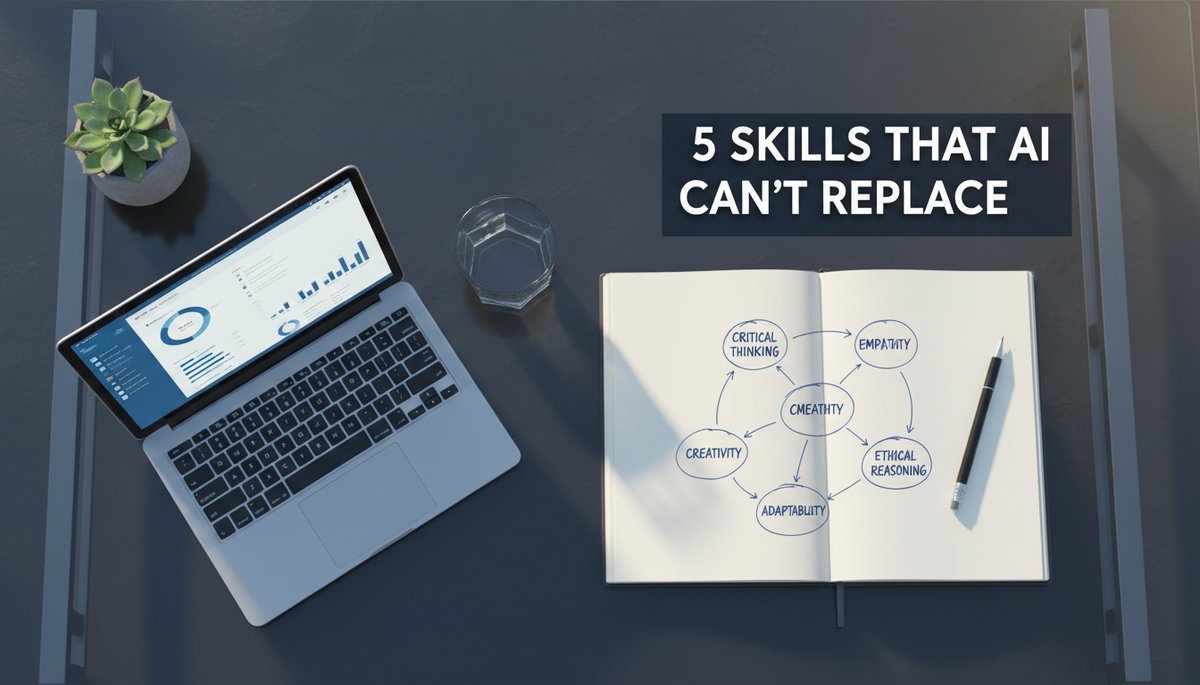
AI-Proof Your Career: 5 Skills That Actually Matter 2026
Every job post now asks for "AI experience." Every LinkedIn influencer tells you to learn prompt engineering. Meanwhile, your actual career anxiety — "Will I still be relevant in five years?" — goes unanswered. The skills most worth building in 2026 are not AI tutorials. They are the five meta-skills that make you the person AI works for, not the person AI replaces.
These skills are not soft platitudes. They are precision tools that translate directly into hiring leverage, promotion velocity, and compensation growth — and they compound in value exactly as AI improves.
Disclosure: This post contains affiliate links. If you click through and purchase a course, we may earn a commission at no extra cost to you. We only recommend resources we stand behind.
Why Most AI Career Advice Misses the Point
The "learn AI tools" advice is not wrong. It is just insufficient. Knowing how to use Copilot or Claude makes you more productive today, the same way knowing Excel made you more productive in 2005. Productivity tools become table stakes. They do not differentiate you.
The professionals thriving right now — and the ones who will thrive in five years — share a different quality: they understand what work actually is at the organizational level. They know which problems need solving, who needs to be convinced, and what a good decision looks like under uncertainty. AI augments their judgment. It cannot manufacture it.
The five skills below operate at that level. Each one has three things in common:
- It gets harder to fake as stakes increase
- It improves with experience in ways AI training data cannot replicate
- It opens doors to roles where AI is a lever you pull, not a threat you dodge
For context on how this fits into your broader career positioning, the guide on job searching in the AI era covers the tactical side — this post covers the foundational capability layer underneath it.
Skill 1: AI Orchestration (Not AI Use)
There is a meaningful difference between using AI and orchestrating it. Using AI means prompting ChatGPT to draft an email. Orchestrating AI means designing a workflow where AI handles research synthesis, a specialist reviews the output, another AI layer formats it for distribution, and you manage the quality gates throughout.
Orchestration is the skill that pays. Organizations are not struggling to find people who can chat with an AI. They are struggling to find people who can build and manage AI-augmented workflows that actually deliver consistent results at scale.
How to build this skill:
- Map one recurring process in your current role and redesign it with AI handling specific steps. Document what works, what breaks, and why.
- Learn basic prompt chaining — giving AI outputs as inputs to subsequent AI tasks. No coding required.
- Study how AI is being used in your industry specifically. What are the failure modes? Where does human oversight still matter?
The premium job titles: AI Implementation Manager, Head of AI Workflows, Senior Operations Lead (AI-Augmented). These roles pay 20-40% above equivalent non-AI positions and are actively underserved in 2026.
Skill 2: Stakeholder Management and Influence Without Authority
This is the skill that scales your impact regardless of your org level — and it is the one AI is furthest from replicating. AI can draft a persuasion strategy. It cannot read the room, sense which executive is quietly resistant, or build the relationship that makes a critical approval happen.
Influence without authority means getting things done through people who do not report to you. This is what product managers, senior analysts, and experienced project leads do every single day. For a deep look at how this plays out in practice, the remote product management career guide breaks down the exact influence mechanics that separate junior PMs from senior ones.
How to build this skill:
- Volunteer to lead cross-functional projects even when you are not the most senior person in the room
- Practice stakeholder mapping: before any significant initiative, write out who needs to approve it, who will resist it, and why
- Study the work of Robert Cialdini and Chris Voss — not as manipulation tactics but as vocabulary for understanding how decisions actually get made
The premium job titles: Program Manager, Senior Product Manager, Director of Strategic Initiatives. Compensation scales sharply with demonstrated stakeholder impact.
Skill 3: Systems Thinking and Root Cause Analysis
Every organization produces symptoms. Deadlines slip. Customer churn rises. A product feature gets poor reviews. The professionals who get promoted fastest are not the ones who react to symptoms — they are the ones who trace problems to their structural source and fix them there.
AI is good at pattern recognition in data. It is poor at understanding the organizational, behavioral, and incentive-based dynamics that create those patterns. That gap is your career advantage.
Systems thinking means seeing cause-and-effect across time and across departments. It means recognizing that the sales team's pipeline problem might actually be a product positioning problem that originates in a market segmentation decision made two years ago.
How to build this skill:
- Learn the "5 Whys" framework and apply it ruthlessly to every recurring problem you encounter at work
- Read "Thinking in Systems" by Donella Meadows — it is the clearest framework available for building this mental model
- Practice writing structured problem statements: observed symptom, hypothesized root cause, evidence for and against, proposed structural fix
For roles where systems thinking is central, the data analyst career path provides a concrete example of how this skill translates into analytical decision-making at the senior level.
The premium job titles: Senior Business Analyst, Head of Operations, VP of Product Strategy. These roles select explicitly for structured thinking under complexity.
Skill 4: Judgment Under Ambiguity
This is the rarest of the five skills and the highest compensated. Most professionals are uncomfortable making calls when data is incomplete, stakeholders disagree, and the stakes are real. That discomfort is precisely the gap AI cannot fill.
AI optimizes within defined parameters. It cannot decide what parameters matter, how to weigh competing values, or when to act despite uncertainty rather than waiting for more data. Judgment under ambiguity is the skill that defines senior leadership.
What this looks like in practice:
- A director decides to ship a product feature with known bugs because the market timing outweighs the quality risk
- A senior analyst recommends canceling a high-visibility campaign based on early signal data, knowing they will be questioned
- A team lead makes a restructuring call without full information because delay has its own cost
How to build this skill:
- Put yourself in roles that require decisions, not just recommendations. Volunteer for projects with genuine consequence.
- Start a decision log. For every significant call you make, write down your reasoning, what you expected to happen, and what actually happened. Review it quarterly.
- Study post-mortems from your industry — what did experienced professionals decide, what was their reasoning, and where did judgment differ from data?
The premium job titles: Chief of Staff, Senior Director, General Manager. At this level, judgment is the product.
Skill 5: Continuous Skill Compounding
The final meta-skill is a process, not a capability: learning how to learn at a pace that keeps you ahead of the curve. The professionals who stay relevant across multiple technology shifts are not lucky. They are deliberate about how they acquire and apply new skills.
Compounding works in careers the same way it works in finance. A 15% improvement in capability each year produces a different career trajectory than a 5% improvement compounded over a decade. The gap widens dramatically over time.
A concrete compounding strategy for 2026:
- Identify one skill per quarter that is adjacent to your current strength and is rising in market value
- Learn it at the application level, not just the conceptual level — build something, write something, or solve a real problem with it
- Connect it to your existing strength to create a combination that is rarer than either skill alone
For structured, high-quality learning, Domestika offers professional courses in creative and strategic skills — presentation design, visual communication, brand strategy — that complement the technical work most professionals already do. The combination of technical depth and communication skill is consistently undervalued and overcompensated.
The meta-principle: Do not optimize for what is in demand right now. Optimize for the capability combinations that will be rare and valuable in 36 months.
How These Five Skills Interact
These skills are not independent. They compound together.
A professional with AI orchestration skills and systems thinking can redesign processes and actually implement them. Add stakeholder management and they can get organizational buy-in. Add judgment under ambiguity and they can lead the initiative through the inevitable obstacles. Add continuous skill compounding and they repeat this cycle across every technology shift for the next twenty years.
This is the professional profile that commands senior compensation and genuine job security — not because AI cannot replace them, but because organizations cannot function without people who operate at this level.
Where to Start
If you are mid-career and feeling the pressure of AI displacement, the instinct to learn more tools is understandable but insufficient. Here is a more actionable starting point:
- Audit which of the five skills you already have evidence for — projects led, decisions made, problems traced to root cause
- Identify the one skill where you have the least evidence and the most latent potential
- Design a 90-day experiment: one project, one practice, one concrete output
The goal is not to master all five simultaneously. It is to build a credible, evidenced story around at least three of them — and to make that story visible in how you present yourself, how you interview, and how you operate in your current role.
AI is not the threat. The threat is staying still while the definition of professional value shifts underneath you. These five skills ensure that no matter how AI evolves, you are on the right side of that shift.
Ready to position yourself for AI-era roles? Start with the comprehensive guide to job searching in the AI era — built for professionals who want to move strategically, not reactively.
Related Posts

Monday.com Cuts 20% of Staff in AI Pivot

AI in Courts Is Rewriting Legal Career Skills