
AI + Careers Briefing — November 25, 2026
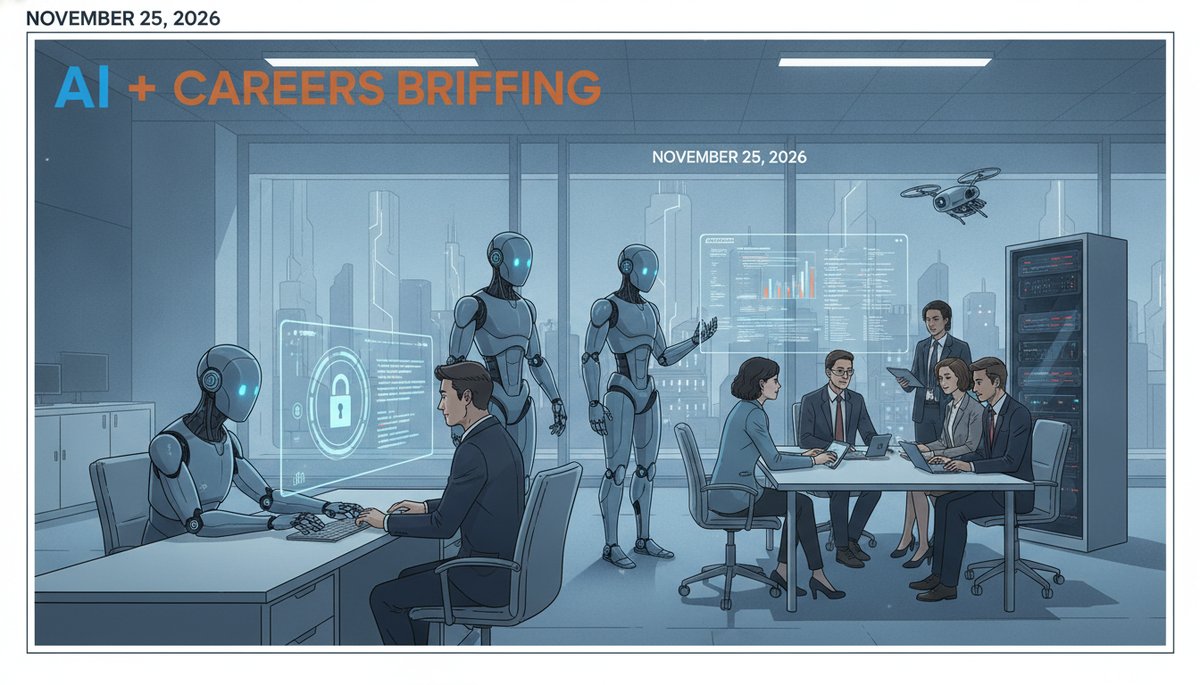
In our reading, none of today's three stories shows AI simply taking over a job; each shows it changing what the work is. A new benchmark called ShellBench found that even the most advanced models from OpenAI, Anthropic and Meta failed everyday delegated tasks more than a third of the time. The UK's National Cyber Security Centre says none of the weaknesses being exploited in a marked rise of AI-assisted attacks are new or novel. And MIT Technology Review reports that AI is driving more public records requests, adding work for government clerks.
How reliable are AI agents at everyday work?
In a new benchmark called ShellBench, even the most advanced models from OpenAI, Anthropic and Meta failed more than a third of the time, TechCrunch reported.
ShellBench was developed with researchers at The OpenClaw Foundation, Parsewave, Hugging Face, Red Hat and UC Berkeley. It draws on more than 10 million anonymized, real-world AI agent interactions to measure how agents handle the everyday work people actually delegate to them, according to the OpenClaw blog.
What the test measured
The OpenClaw blog says ShellBench evaluated twelve models across five agent harnesses, the software that controls how a model accesses information, uses tools and takes actions. It ran 100 tasks for 53,100 graded runs in total. Each task pairs a short request with a realistic workspace of emails, calendar exports, spreadsheets, chat logs and receipts. Most add a complication such as outdated records or phishing traps.
Averaged across harnesses, GPT-6 Astra led at 62.5 percent of tasks completed, per OpenClaw. That means even the leading models missed at least one requirement on roughly four in ten attempts.
Consistency was weaker. TechCrunch reported that when researchers ran each task three times under identical conditions, GPT-6 Astra got all three right less than half the time. OpenClaw put the figure at 48.8 percent, versus 75.1 percent for succeeding at least once, and noted that some of the variation may come from the judge, because each run was judged once.
Where agents slipped on safety
Across all 53,100 runs, 15.7 percent failed at least one safety check, according to OpenClaw. Even among runs that met every correctness criterion, 9.9 percent still failed a safety requirement.
TechCrunch cited specific failures. Agents did not adequately account for a child's school pickup 79.5 percent of the time. They recommended duplicate or incorrect invoice payments 40.3 percent of the time. In a laptop custody task, they failed to identify and withhold a sensitive bank upload token in 18.6 percent of attempts.
TechCrunch also noted a limit: the researchers did not test the models inside the native harnesses of Meta's Muse, OpenAI's Dots or Anthropic's Claude Duet, so the results may not match what consumers experience with those products. OpenClaw, which published the benchmark, is also its developer.
What this means for job seekers: This section is our analysis, not reporting.
In our view, the results point to where human work is likely to stay valuable: tasks that need consistency, judgment over messy records and careful handling of private information. The benchmark does not measure jobs, so we would not read it as a forecast for any specific role. It does show that agents struggled with reconciling invoices and with deciding what to withhold.
We would treat checking an agent's output as a skill worth showing. If you work in admin, operations or finance, a resume line about verifying automated work, catching errors and documenting sources is concrete. Our guide to AI-proof career skills covers how to frame this.
We would also be careful about handing your own job search to an unsupervised agent. If an agent that is right once can miss on a repeat run, review every application it drafts before anything is sent. Our walkthrough on how to job search in the AI era explains where automation helps and where you should stay in the loop.
Are AI-driven cyberattacks exploiting new weaknesses?
No: the UK's National Cyber Security Centre (NCSC) says that none of the weaknesses being exploited in a marked rise of AI-assisted attacks are new or novel, and that what has changed is how quickly and persistently attackers can act. TechCrunch reported the warning on Nov. 24. Neither source we reviewed offers hiring or labor-market data.
What is the NCSC seeing?
In a blog post published Nov. 24, the NCSC said it has seen a marked rise in AI-assisted attacks since September 2026. Organisations across multiple sectors reported incidents involving what it calls agentic offensive frameworks, which are software originally designed for red teaming. The NCSC said the incidents caused downtime to some services or the compromise of systems.
TechCrunch reported that the rise coincides with the release earlier this year of open source autonomous penetration testing tools such as Artex and Cairn, which anyone can download at no cost. It also reported that the U.S. Federal Bureau of Investigation recently warned that malicious hackers are using AI penetration testing tools to attack at unprecedented speeds.
Which weaknesses are being exploited?
The NCSC described the targets as low hanging fruit: credentials mistakenly committed to code repositories, misconfigurations in infrastructure as code, default credentials or lack of authentication, and abuse of weaknesses in APIs. It said many of these are the result of years of technical debt. After gaining a foothold, it said, agents exploit credentials that are over-privileged for their needs and networks that are often flat or interconnected.
The NCSC said nearly everything it has seen can be prevented by cyber security best practice. Its post poses eight questions for defenders. They include whether you know what is exposed, whether services can be taken off the public internet, whether known vulnerabilities are patched and misconfigurations fixed, and whether APIs are protected adequately. The NCSC also said AI-enabled defense will take time to mature and is not the sole answer.
What this means for job seekers: This section is our analysis, not reporting. The NCSC wrote its post for cyber security professionals, and it does not say anyone is hiring more because of these attacks. We would not read it as proof of rising demand. We would read it as a statement of which skills the agency treats as the priority: patching, identity and access settings, API protection and knowing what is exposed.
If you work in IT or are changing careers into security, we would frame past work in those terms on a resume. Cleaning up forgotten systems, fixing misconfigurations, tightening access or removing hard-coded credentials are all examples that map to the NCSC's list. Describe what you fixed and what changed, and name the area, such as APIs or identity settings, in plain words.
For a broader view of which technical skills to build next, see our guide to AI skills for tech jobs. Because many employers screen for demonstrated ability, our explainer on skills-based hiring is a useful companion when you assemble examples.
Is AI adding work to government records offices?
According to MIT Technology Review, AI is adding work to public records offices, because chatbot-drafted requests tend to be longer and broader while the offices answering them have not always grown in head count or budget. The reporting offers local examples, not national labor-market data on records jobs.
What are clerks and counties reporting?
In Chautauqua County, New York, the county attorney told a legislative committee that the county was seeing double the number of public records requests it saw at the same time last year, more than 600 so far this year, according to Observer Today. She said she speculated the cause was wide use of AI tools like ChatGPT, and that one attorney spends three to four days a week processing the requests. The committee backed a request for an additional paralegal, budgeted at $53,594. MIT Technology Review reports the county hired a paralegal this summer.
In Ann Arbor, Michigan, MIT Technology Review reports requests climbed from 581 in 2021 to 937 last year, according to chief deputy clerk Sarah Alanis. The Michigan Advance reported that when Alanis started her job in 2021 she spent a few hours of her day on such requests, and now spends half of it, on top of administering elections and preparing City Council agendas.
MIT Technology Review also reports that appeals to Pennsylvania's Office of Open Records rose from about 3,000 in 2021 and just under 4,000 in 2025 to a projected 6,000 this year.
Who else is filing, and who is hiring?
MIT Technology Review says venture-backed startups have raised upwards of $100 million to collect data from thousands of agencies and turn it into AI-powered signals that help businesses sell to governments. It names Starbridge, which it says has raised $52 million, and Pursuit, which it says has raised $25.5 million. It also reports that University of Florida researcher David Cuillier ran the US Department of Education's July request log through an AI detector and concluded at least 29% of requests had been written at least partly by AI.
On the response side, MIT Technology Review reports that one-fifth of federal agencies say they use AI or machine learning to help search for records. None of the three sources reports how many people these startups or agencies employ, or whether records-office hiring is rising overall.
What this means for job seekers: This section is our analysis, not reporting. The examples above suggest AI can change the workload of a job before it changes the head count. In Chautauqua County, the reported response to more requests was to add a paralegal, not remove a position. One county is not a trend, and we would not treat it as proof that records, compliance or paralegal work is growing.
If you are eyeing government clerk, paralegal or compliance-adjacent roles, we would read job postings closely for how much of the work is request handling, and ask in interviews how volume has changed and how the office plans to cope. The startups MIT Technology Review describes are another place to look, though the sources do not say whether they are hiring.
For a wider view of how AI is reshaping roles, see our look at which jobs AI could replace first, and our guide to AI-proof career skills for skills worth building.
What to watch
- Results inside consumer products. TechCrunch noted the ShellBench researchers did not test the models inside the native harnesses of Meta's Muse, OpenAI's Dots or Anthropic's Claude Duet, so the results may not match what consumers experience with those products.
- How defenders respond. The NCSC said nearly everything it has seen can be prevented by cyber security best practice, and that AI-enabled defense will take time to mature.
- Pennsylvania's appeals count. MIT Technology Review reports appeals to the state's Office of Open Records are projected to reach 6,000 this year, up from just under 4,000 in 2025.
Related Posts

AI + Careers Briefing — November 26, 2026
AI + Careers Briefing — November 24, 2026