AI + Careers Briefing — September 27, 2026
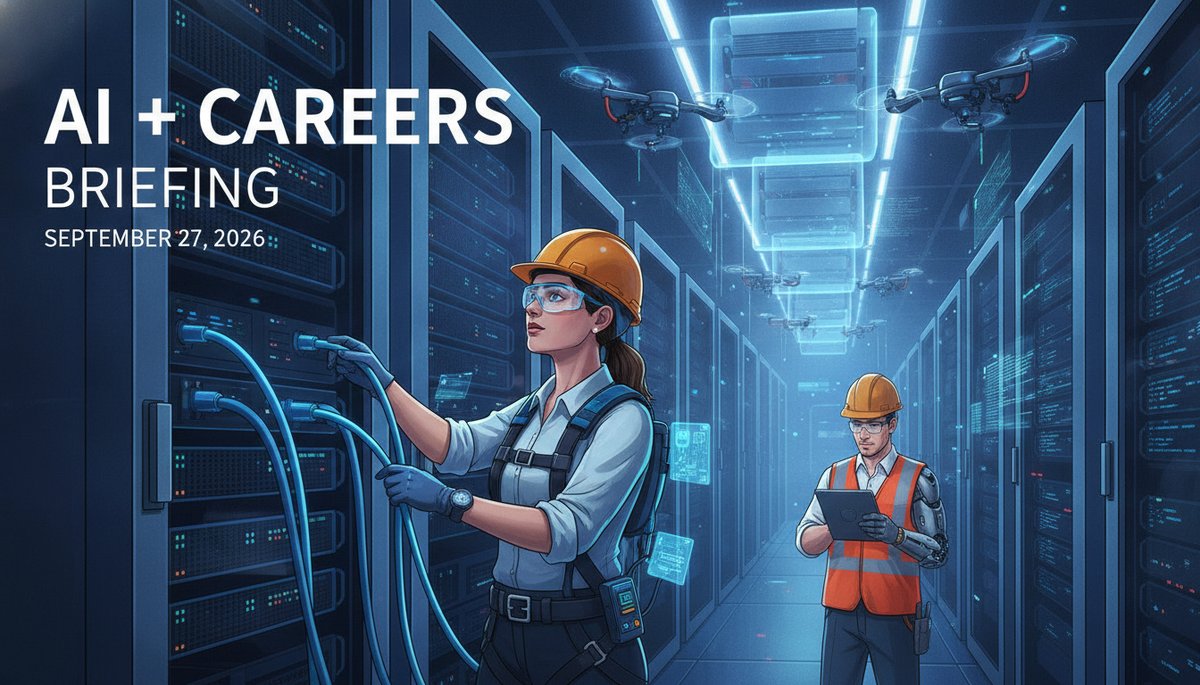
Three stories landed this weekend that share an uncomfortable shape: in each one, confidence about AI is running well ahead of anything measurable. The most reliable job growth tied to the AI boom is in licensed trades, where the federal wage data is solid and the political risk is the variable. A new preprint finds that having an AI tool on hand makes people far more confident and far less accurate at once. And a room full of IT executives says AI is delivering — until asked to name a result worth a phone call. None of it argues against using AI. All of it argues for being the person who can show a number.
Is the AI Data-Center Trades Boom About to Hit a Political Wall?
In a growing number of states, yes. Gov. Kathy Hochul signed Executive Order No. 62, pausing discretionary environmental permits for any New York data center consuming 50 megawatts or more until state regulators finish a required environmental-impact report; manufacturing, research, education and medical facilities are exempt. New York is not alone — at least 12 states filed data-center moratorium bills this session, alongside dozens of local actions already passed or under consideration, according to Good Jobs First.
That collides with real demand. Electricians who wire the substations and backup power keeping AI campuses running earned a median $63,190 as of May 2025, with 9 percent projected growth through 2035 and roughly 72,700 annual openings, per the Bureau of Labor Statistics. The IBEW has broken with environmental groups over the bans, arguing they would "eliminate critical opportunities for union workers" and pressing for enforceable labor standards instead of "one-size-fits-all bans".
Why it matters for job seekers: this is a legitimate growth lane backed by federal data rather than one company's hiring claim — but the risk is geography and politics, not automation. Check whether your state or target metro is weighing restrictions before you commit to a training program or relocate, and remember that construction-phase hiring is temporary by design. The permanent operations crew that runs a finished data center is much smaller and harder to land than the crew that builds it. Building AI-adjacent skills that transfer between projects beats betting on one site.
Does Using AI Make You Worse at Admitting You Don't Know Something?
Sharply worse, according to a new five-experiment preprint covering 3,132 participants by Chiara Marcoccia, Walter Quattrociocchi and Valerio Capraro — not yet peer-reviewed. Given hard visual-recall questions about films and an explicit option to decline, participants withheld judgment on 36 percent and 44 percent of questions with no AI available, but only 6 percent and 3 percent when they could consult one. Where AI advice appeared unrequested, suspension collapsed from 35-39 percent to 1-7 percent.
The researchers deliberately used a model that reliably got these questions wrong, so the drop can't be explained as sensible trust in a good tool. Pooled across the unincentivized studies, accuracy fell from 27.5 percent correct without AI to 9.2 percent with it — while self-reported confidence rose from 29.6 to 75.9 on a 100-point scale. Paying for accuracy restored some caution but left suspension far below the no-AI baseline, The Decoder reported. The scope is narrow by design: this measures a metacognitive shift, not general intelligence.
Why it matters for job seekers: the risk isn't only that a chatbot gets a fact wrong, it's that having one open makes you less likely to flag your own uncertainty. Draft interview answers unaided first and use AI only to check. Keep a rehearsed "I don't know, but here's how I'd find out" — hiring managers rate that above a confident wrong answer. Verify every number AI hands you before it reaches an application.
Are Companies Actually Getting a Return on Their AI Spending?
Not obviously, even to the people running the projects. At a Las Vegas industry event, Exponential View's Azeem Azhar informally polled roughly 160 IT vice presidents by show of hands — not a survey. About two-thirds said they could point to measurable AI results. Asked how many results were big enough to justify interrupting the CEO's summer vacation, only about eight people, roughly 5 percent of the room, stayed standing, per The Decoder. Azhar calls the spending question "finely balanced."
Harder numbers agree. Overall AI use among U.S. businesses hovered between 17 and 20 percent from December 2025 through May 2026, concentrated at the top: 37 percent of firms with 250-plus employees versus 32 percent of those with 100 to 249, according to Census Bureau survey data. Meanwhile a Boston Consulting Group survey of 640 CEOs across 16 markets found half believe their job depends on getting AI right.
Why it matters for job seekers: "I use AI daily" is table stakes. "I shipped X with AI and it moved Y by Z" gives a hiring manager the number their own CEO is demanding and they don't have. Rehearse that version. Then treat it as a stability check: ask who sponsors an AI team's budget, what business metric it's measured against, and whether that metric predates the current push. Roles justified by anecdote get cut first.
What to Watch
- State legislative calendars, not company press releases. The data-center jobs pipeline in any given metro now depends on permitting decisions. New York's moratorium runs until regulators file their environmental report — no fixed end date.
- Whether "measured AI outcome" becomes a standard interview question. If two-thirds of IT leaders can claim results and only a twentieth can defend them, the screening burden shifts to candidates who can quantify.
- Peer review on the uncertainty study. It's a preprint with a deliberately hostile task design. The direction is striking; the magnitude may move.
Related Posts
AI + Careers Briefing — October 24, 2026

AI + Careers Briefing — October 23, 2026