Working Remotely from Mexico City: 2026 Guide
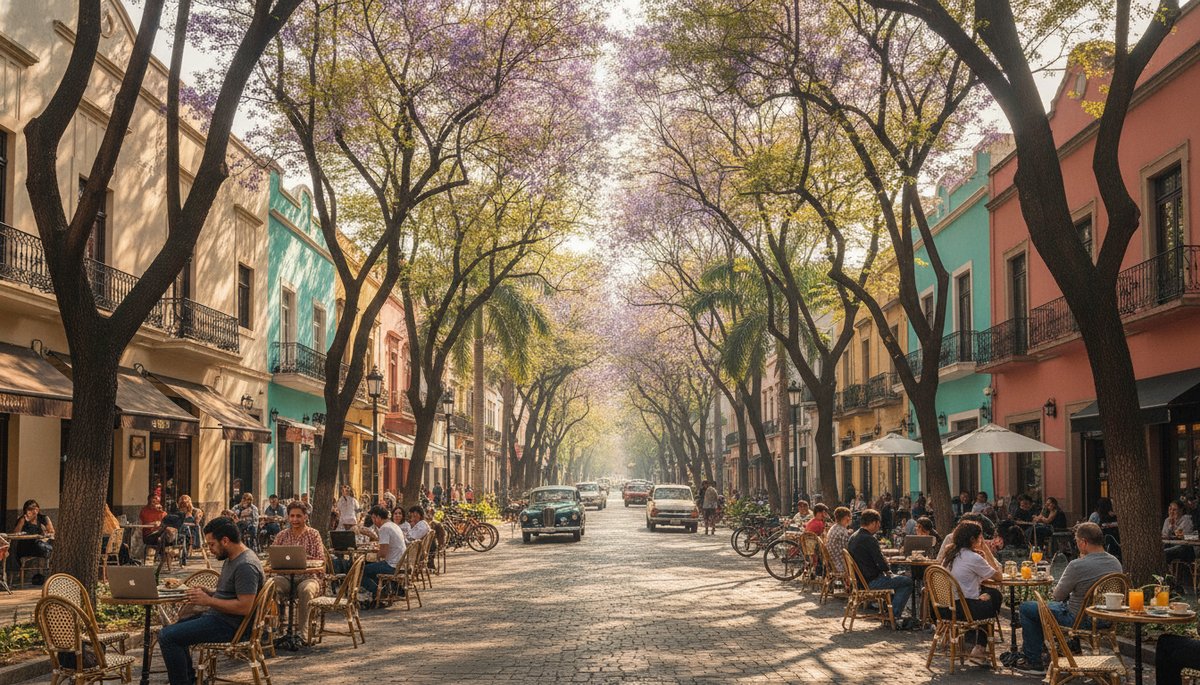
Working Remotely from Mexico City: A 2026 Guide for Remote Workers
Mexico City (CDMX) has quietly become the default relocation choice for US-based remote workers who want a lower cost of living without surrendering their employer's business hours. At 2,240 meters above sea level, on Central Time, and with a coworking scene that rivals Lisbon or Chiang Mai, CDMX makes a compelling case on nearly every dimension that matters to someone working a full-time remote role.
This guide covers what you actually need to know before making the move: verified cost-of-living ranges, the best neighborhoods for remote work, the real internet picture, how the visa math works, and an honest safety read.
Quick Answer: Working remotely from Mexico City in 2026 is practical, affordable, and well-supported by infrastructure. A comfortable solo setup runs roughly $1,500–$2,400 USD per month. The city is on US Central Time, fiber internet reaches most expat neighborhoods, and coworking options are plentiful. The main long-term legal path is the Temporary Resident Visa; income or savings thresholds apply.
Is Mexico City Good for Remote Work?
Mexico City is one of the strongest remote-work bases in the Western Hemisphere. The combination of Central Time alignment, affordable professional infrastructure, and a large existing English-fluent expat community means the friction of relocating here is unusually low compared to other cost-of-living arbitrage destinations.
The city has over 20 million residents in its metro area and a mature startup and tech ecosystem — which means coworking spaces, fast-food-grade coffee shops with outlets, and fiber ISPs are not novelties but standard features of the neighborhoods where most remote workers settle. CDMX also hosted a growing number of pre-World Cup 2026 visitors this year, further elevating its international infrastructure.
The caveat worth naming upfront: CDMX is a megacity. Altitude adjustment takes a few days, air quality during thermal inversions (typically November–April, the dry season) can be poor, and seismic activity is a real background reality. These are manageable facts of life, not dealbreakers — but they belong in any honest assessment.
What Does Mexico City Cost for Remote Workers in 2026?
A realistic solo budget runs roughly $1,500–$2,400 USD per month, covering rent, food, coworking, transport, and discretionary spending. Where you land in that range depends almost entirely on your housing choice.
Here is a working monthly breakdown based on data from multiple 2026 nomad and expat guides:
Category | Monthly Range (USD) | Notes |
|---|---|---|
Rent (furnished 1BR, expat neighborhoods) | $700–$1,200 | Roma Norte, Condesa, Juárez; Polanco runs higher |
Food (mix of home cooking + restaurants) | $300–$600 | Market meals $3–$8; mid-range restaurants $12–$25 |
Coworking membership | $115–$260 | Público (budget) to WeWork (premium) |
Transport | $50–$100 | Metro roughly $0.30/ride; Uber/Didi $3–$6 per trip |
Water, utilities, household | $30–$60 | Bottled water is a genuine recurring cost citywide |
Social / discretionary | $150–$300 | Coffee shops, entertainment, phone plan |
Total estimate | $1,345–$2,520 | Lower end assumes long-term lease + home cooking |
Note on rent: Airbnb short-term rates in CDMX run significantly higher than long-term leases. If you arrive and rent month-to-month while apartment hunting, budget in a higher first-month housing cost. Securing a 6–12 month lease in neighborhoods like Roma Norte or Juárez is the most reliable way to hit the lower end of the range above.
What Are the Best Neighborhoods in CDMX for Digital Nomads?
The following four neighborhoods account for the large majority of remote workers in Mexico City. Each has a distinct character and price profile.
Roma Norte and Roma Sur
Roma Norte is the epicenter of CDMX's remote-work scene. Art-deco architecture, tree-lined streets, dozens of cafe-coworking hybrids, and walkable access to grocery markets and restaurants make it the default first choice. Roma Sur sits just south and is slightly quieter and modestly cheaper.
Rent for a furnished one-bedroom in Roma Norte currently runs roughly $700–$1,200 USD per month on a long-term lease, based on 2026 listing data.
Condesa
Condesa (especially Hipódromo Condesa) is Roma's neighbor and shares much of the same appeal: tree canopy, good walkability, and a well-established international crowd. It is marginally pricier than Roma Norte, with furnished one-bedrooms in a similar range of $900–$1,200 USD per month.
Juárez (Zona Rosa)
Juárez is the most central and often the most affordable of the three popular expat zones, typically running 10–20% cheaper than Roma for comparable apartments. It is denser and more commercial but well-connected and increasingly popular with remote workers who want to be close to Paseo de la Reforma.
Polanco
Polanco is the upscale option — embassy row, luxury hotels, and top-end restaurants. Rents are the highest in the city for furnished apartments, often $1,800–$3,000+ USD per month. It is quiet, walkable, and low-crime, which suits remote workers who prioritize a calm residential feel and have the budget.
What Is the Internet and Connectivity Like for Remote Workers in Mexico City?
Mexico City's fiber infrastructure in its central neighborhoods is genuinely good. Residential fiber services from providers like Totalplay and Telmex commonly deliver 100–200 Mbps download in Roma, Condesa, and Polanco.
Coworking spaces in expat neighborhoods consistently deliver usable speeds:
Coworking Space | Monthly Cost (approx.) | Reported Speeds |
|---|---|---|
Público (Roma Norte) | ~$115 USD | 50–100 Mbps |
Homework (Roma / Condesa) | ~$130 USD | 80–160 Mbps |
Selina Roma Norte | ~$155 USD | 60–130 Mbps |
WeWork | ~$260 USD | 100–300 Mbps |
The practical consideration is apartment-level variability. Older buildings sometimes have aging internal wiring that limits speeds regardless of the ISP plan. Always verify the building's fiber status before signing a lease.
For your first weeks in Mexico City, an eSIM makes sense as a data backup when you are still establishing your home setup. Airalo's Mexico eSIM plans run on the Movistar network and currently range from about $5.50 for a short-stay data plan up to $59 for a 30-day unlimited plan, which keeps you covered while getting settled.
Affiliate link — we may earn a commission at no extra cost to you if you purchase an Airalo eSIM.
Does Mexico City's Time Zone Work for Remote Jobs?
Yes — this is one of CDMX's biggest advantages. Mexico abolished daylight saving time in October 2022, so Mexico City runs on Central Standard Time (CST, UTC-6) permanently — there is no seasonal clock change. Your schedule never shifts relative to your employer.
The practical overlap picture depends on where your team sits. When the US is on standard time (November through early March), CDMX aligns exactly with US Central time and sits one hour behind US Eastern. When the US observes DST (mid-March through early November), CDMX stays fixed while US clocks spring forward — so CDMX runs one hour behind US Central and two hours behind US Eastern during that period. Either way, core US business hours are fully covered from CDMX. This is a substantive edge over popular alternatives like Lisbon (5–6 hours ahead of the US East Coast) or Southeast Asian cities where real-time collaboration requires very early or late sessions.
If you are still searching for a remote role that will actually support this lifestyle, our guide on how to find a remote job in 2026 covers the most effective channels and application strategies. It is also worth timing your search around hiring seasons — the September hiring surge is one of the strongest windows of the year for remote role openings.
What Are the Visa Options for Remote Workers in Mexico City?
There are two main paths, and they work differently.
The Tourist Entry (FMM)
Citizens of many countries — including the US, Canada, EU member states, UK, and Australia — can enter Mexico without a visa. At the border or airport, an immigration officer issues an entry permit (the FMM, now mostly digital for air arrivals) that authorizes a tourist stay. The maximum authorized stay is 180 days, though the actual number granted is at the immigration officer's discretion and is often shorter.
Legally speaking, working remotely for a foreign employer on tourist status is a grey area in Mexican immigration law — the FMM covers tourism and leisure, not employment. In practice, many short-stay remote workers operate on tourist entry, but this should not be mistaken for explicit legal authorization to work. If you plan to stay long-term, the Temporary Resident Visa is the appropriate route.
The Mexico Temporary Resident Visa
The Temporary Resident Visa (Visa de Residente Temporal) is the formal long-term path. It allows stays of one to four years, is renewable, and can eventually lead to permanent residency.
To qualify in 2026, you must demonstrate to a Mexican consulate (before you enter Mexico) either:
Stable monthly income of roughly $4,200–$4,400 USD per month for the prior 6 months, from foreign sources, or
Savings or investments of roughly $70,000–$74,000 USD held for the prior 12 months.
You need to meet one threshold, not both. These figures are derived from UMA (Unidad de Medida y Actualización) calculations, are peso-denominated, and are therefore exchange-rate-dependent — the USD equivalent can shift. The UMA-based thresholds were expected to be adopted across all consulates in 2026, but individual consulates retain discretion and their requirements can differ. Always confirm the exact figures directly with the Mexican consulate in your country before applying, as the range above is approximate and changes annually.
The application involves an appointment at a Mexican consulate abroad, a financial documentation packet (bank statements, pay stubs, or proof of investment balances), and a fee. Successful applicants receive a consular sticker that they exchange for a resident card (tarjeta de residente) after entry.
Do I Need a Remote Job Before Moving to Mexico City?
Technically no — you can explore the city on tourist entry and job-hunt from there. Practically, having your remote role locked before you relocate removes significant financial uncertainty, since rent deposits, furnished apartment premiums, and setup costs arrive all at once.
If you are in job-search mode, platforms that pre-screen roles for legitimate remote flexibility save time and reduce fraud risk. FlexJobs vets every company and listing before it appears on the platform — a meaningful filter when you are looking for roles that will actually support a location-independent lifestyle.
Affiliate link — we may earn a commission at no extra cost to you if you subscribe to FlexJobs.
Disclosure: This post contains affiliate links to Airalo and FlexJobs. If you make a purchase or subscribe through these links, we may earn a small commission at no extra cost to you. We only recommend products and services relevant to this guide.
Is Mexico City Safe for Remote Workers?
The US State Department currently rates Mexico City (CDMX) at Level 2: Exercise Increased Caution — the same advisory level applied to dozens of major international cities. CDMX holds this rating separately from the higher-risk Mexican states (several of which carry Level 3 or Level 4 advisories), and the capital's practical security picture is different from border or coastal areas with elevated cartel activity.
The risks most relevant to daily life in Roma, Condesa, Juárez, or Polanco are petty theft, Metro pickpocketing, and occasional drink-spiking in nightlife areas — urban hazards familiar from any large international city. Express kidnapping incidents have been reported and are worth awareness, though they are not a defining feature of the tourist and expat zones.
Practical habits that cover most risk:
Use Uber or Didi rather than hailing street taxis, particularly at night.
Avoid displaying laptops, cameras, or high-value phones openly in crowded transit.
Stay alert on Metro lines, especially during rush hours.
Stick to well-lit, busy streets after dark in unfamiliar areas.
Check current conditions with the US Embassy's security alerts page (mx.usembassy.gov) before and after arrival.
The millions of residents and tens of thousands of international remote workers based in CDMX treat these precautions as ordinary urban habits rather than exceptional hardship.
What Is It Like to Live in Mexico City as a Remote Worker?
The lifestyle case for CDMX goes well beyond the numbers. The food scene is one of the best in the world at every price point — from $2–$3 market tacos to James Beard-recognized tasting menus. The cultural calendar is dense: museums, live music, markets, and some of Latin America's most vibrant street life are all within walking distance of most expat neighborhoods.
September in particular is worth flagging for anyone planning around Mexican Independence season. The weeks leading up to September 16 fill the city with events, decorations, and a festive energy that makes an already-livable city feel genuinely celebratory. For remote workers who want to experience CDMX as a place rather than just a backdrop, timing an arrival for August or early September captures this season naturally.
The four-day workweek is gaining traction in 2026, and Mexico City is one of the places where the lifestyle case for it is most tangible — long weekends in a city this rich in culture and within short flying distance of the Pacific coast, the Yucatán, and Oaxaca make the extra day genuinely transformative.
Mexico City as a Remote Work Base: Summary
Mexico City in 2026 offers a combination of cost efficiency, professional infrastructure, and quality of life that is hard to match in the same price range. Central Time alignment removes the collaboration friction that hurts US remote workers in other popular destinations. The neighborhoods where most expats settle — Roma Norte, Condesa, Juárez — are safe, walkable, and coworking-dense.
The main preparation items are:
Secure your remote role first if you can — it simplifies the financial calculation significantly.
Understand your visa path before you travel: tourist entry is manageable for short stays but the Temporary Resident Visa is the right route for anything longer than a few months.
Budget for the furnished-apartment premium on arrival and move to a long-term lease as quickly as practical.
Verify internet at the apartment level, not just the neighborhood — building infrastructure varies.
CDMX rewards remote workers who do the homework. For those who do, it regularly becomes one of the best decisions they make.
Frequently Asked Questions
Can I work remotely from Mexico City?
What is the cost of living in Mexico City for remote workers in 2026?
What are the best neighborhoods in CDMX for digital nomads?
What is the Mexico Temporary Resident Visa and how do I qualify?
Is Mexico City safe for remote workers?
Related Posts

AI + Careers Briefing — October 13, 2026

AI + Careers Briefing — October 12, 2026