Skills-Based Hiring 2026: The Reality Gap & How to Win
Skills-Based Hiring in 2026: The Reality Gap and How to Actually Win Under It
Every week, another major employer announces they are dropping degree requirements and hiring on skills. The headlines are real. The gap between those headlines and actual hiring outcomes is also real — and it is wide enough to cost you a job if you misread it.
Quick Answer: Research from Harvard Business School and the Burning Glass Institute (2024) found that despite widespread degree-requirement removals, fewer than 1 in 700 new hires at those companies were workers without a bachelor's degree. About 45% of companies changed their job postings but not their actual hiring. The path to winning under skills-based hiring requires targeting companies where it is genuinely practiced and giving them verifiable proof — not just telling them you have skills.
Disclosure: This post contains affiliate links. If you make a purchase through these links, we may earn a small commission at no extra cost to you. We only recommend products we genuinely believe in.
What Is Skills-Based Hiring?
Skills-based hiring is a recruitment approach where employers evaluate candidates on demonstrated, verifiable abilities rather than using a degree as a proxy for competence. Instead of filtering applicants by education credentials in the initial screen, a genuinely skills-based process uses work samples, portfolio reviews, technical assessments, or structured skill evaluations.
The concept has been gaining traction since the late 2010s, accelerated by tight labor markets and public pressure from workforce advocates. By 2026, it has become one of the most discussed — and most misunderstood — shifts in recruiting.
Is Skills-Based Hiring Actually Happening?
The honest answer is: sometimes, at some companies, in some roles.
A 2024 analysis by Harvard Business School and the Burning Glass Institute — examining firms that publicly removed degree requirements — found that the average increase in hires without a bachelor's degree was just 3.5 percentage points. Fewer than 1 in 700 new hires at those firms were workers without a degree who would not have been hired under the old requirements. The research reviewed over 11,000 roles at large employers before and after degree-requirement removals.
The researchers classified the firms into three categories:
Leaders (37%): Companies that actually increased non-degreed hiring by nearly 20 percentage points after removing requirements.
In-name-only (45%): Companies that updated job postings but saw essentially no change in who they hired.
Backsliders (18%): Companies that made initial progress but then reversed course.
A separate 2025 survey by TestGorilla found that 85% of employers say they use skills-based hiring. The gap between that self-reported 85% and the actual hiring pattern documented by Harvard/Burning Glass is what we call the reality gap.
Why the Gap Exists
Three structural forces keep the gap wide:
Applicant tracking systems (ATS) can silently score degrees as a positive signal even when the job description says "no degree required." The posting changes; the algorithm does not.
Hiring manager habits are slow to change. When a manager has hundreds of applications and limited time, a credential functions as a shortcut — even if company policy discourages it.
"Skills-based hiring" as a recruitment marketing message often precedes any real workflow redesign. A company announces the policy; the actual interview process, rubric, and job architecture remain unchanged.
Understanding this gap is not an argument for cynicism — it is an argument for precision. Applying to the 37% of genuine leaders looks very different from applying to the 45% that are in-name-only. The strategic task is sorting them before you apply.
How Do I Show Skills Without a Degree?
Proof of skill has to be visible before the interview and verifiable during it.
Build a Portfolio of Real Outcomes
A portfolio is the single most effective tool for candidates without traditional credentials. The key is specificity: not "I know Python" but a GitHub repository with documented projects, a case study showing a business problem you solved, or a live site you built. For non-technical roles, a writing portfolio, a marketing campaign with measurable results, or a financial model you built for a real project all serve the same purpose.
Aim for two to four projects that demonstrate the core skills in the roles you're targeting. Quality beats volume.
Earn Recognized Certifications
Certifications from organizations with established employer trust carry weight because they give hiring managers an external signal they can point to. In tech, this includes AWS, Google, CompTIA, and Cisco credentials. In data and analytics, DataCamp offers structured, project-based learning paths that result in shareable credentials for roles in data analysis, data engineering, and machine learning. The skills that remain in demand are also covered in our guide to skills that hold their value in an AI-driven economy.
Affiliate link — we may earn a commission at no extra cost to you.
Take Employer Skills Assessments Seriously
Many companies now offer pre-application skills assessments through platforms like Greenhouse, Workday, or their own tools. Treat them as a first interview, not a checkbox. A strong assessment result can move you past the credential filter entirely — it is objective, comparable, and requires no degree to score well on.
Quantify Everything
Every bullet on your resume should answer: what did you do, and what changed because of it? "Managed social media accounts" is weak. "Grew organic Instagram engagement by 40% over six months by introducing weekly video content" is skills evidence. Employers evaluating skills need proof of outcomes, not descriptions of duties. Review our guide to optimizing your resume for ATS in 2026 for the tactical layer.
How Do I Rewrite My Resume for Skills-Based Hiring?
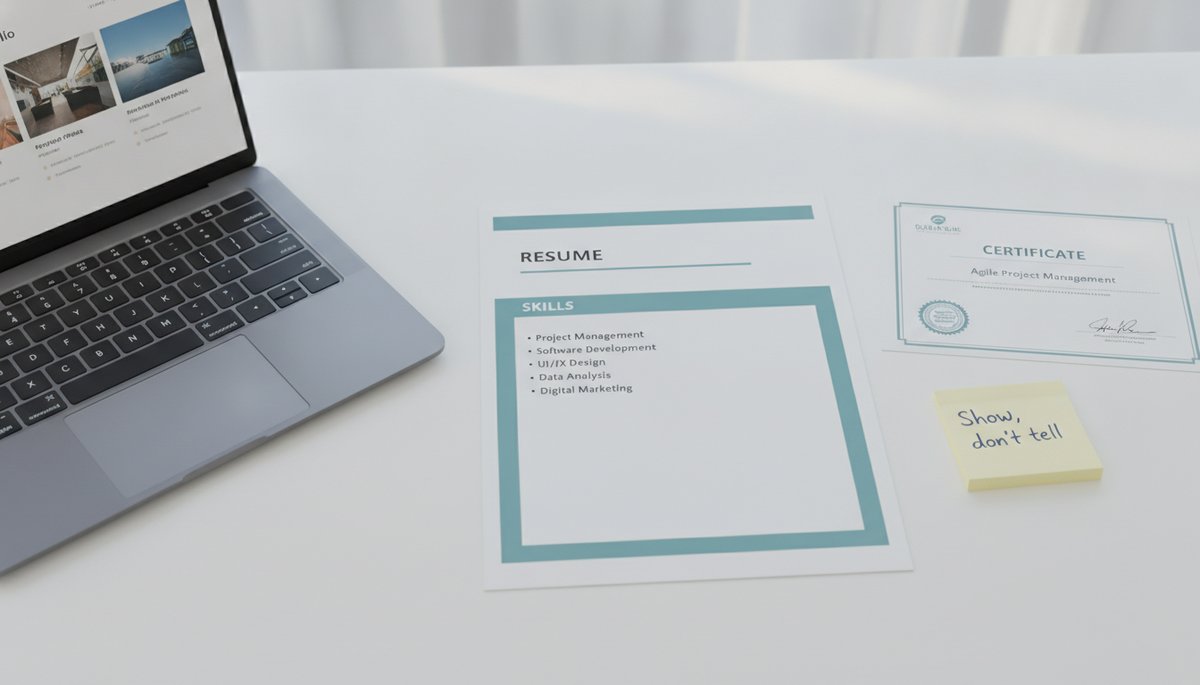
A skills-first resume flips the traditional structure. Instead of leading with education, it leads with a skills summary and demonstrated outcomes.
Structure to use:
Headline and skills summary (top of resume): 2–3 sentences naming your core competency and biggest proof point. "Data analyst with 3 years of Python and SQL experience; built a customer churn model that reduced quarterly attrition by 12%."
Core skills section: A scannable list of hard skills — tools, platforms, languages, methodologies — grouped by category. This is what ATS systems and skills-focused hiring managers scan first.
Experience section: Rewritten as accomplishments, not duties. Each role should have two to three bullet points with a measurable outcome.
Projects: List two to four portfolio projects with a link or outcome metric.
Certifications: Below projects, with issuer and date.
Education: At the bottom, brief. If you have a degree, list it. If you do not, list relevant coursework, bootcamps, or training programs.
The education section does not disappear — it just stops leading. This structure serves both the hiring manager genuinely evaluating skills and the ATS system that may still be scanning for keywords.
Which Companies Actually Hire Based on Skills?
Sorting genuine leaders from in-name-only adopters is a research task, not a guess.
Signs a company is a genuine skills-based hiring leader:
Job descriptions list specific tools, skills, and outcomes — not vague "preferred qualifications" around degrees
The interview process includes a technical assessment or work sample before the offer stage
The company has publicly shared data on non-degreed hire rates or internal mobility for non-degreed employees
Roles in the company have clear skills-based progression paths (not just entry-level postings)
Industries where skills-based hiring is most documented:
Technology: software development, cybersecurity, cloud infrastructure
Data and analytics
Skilled trades and manufacturing
Customer experience and support
Where it remains largely theater:
Finance and consulting at major firms (degree preferences persist strongly in practice)
Healthcare (regulatory licensing requirements overlap with credential screening)
Government and law (formal qualification requirements are often embedded in policy, not just culture)
For remote jobs that don't require a tech degree, the landscape is broader — customer success, content, operations, and marketing roles at remote-first companies often practice more genuine skills evaluation. A vetted platform like FlexJobs filters out scam postings and surfaces legitimate remote opportunities, many of which are at companies that have publicly committed to skills-based evaluation.
Affiliate link — we may earn a commission at no extra cost to you.
What Skills-Based Hiring Actually Changes (and What It Doesn't)
At companies where it is genuine, skills-based hiring has measurable effects. The Harvard/Burning Glass research found that non-degreed workers at leader firms had a retention rate 10 percentage points higher than their degree-holding colleagues. Non-degreed workers hired into roles that previously required degrees also saw an average 25% salary increase compared to similar roles at non-leader firms.
What skills-based hiring does not change: the performance bar once you are in. Your hiring case rests entirely on demonstrated output, which means you need to deliver quickly. Networking and referrals still matter — a referral at a genuine skills-first company is evaluated more fairly, but you still need to get through the door. Also worth noting: the same in-name-only dynamics that drive the skills-hiring gap also produce ghost jobs and how to spot them — postings that were never intended to result in a hire.
The Action Plan: How to Win Under Skills-Based Hiring
Before you apply:
Research whether the company is a genuine leader or in-name-only. Look for skills-based interview formats, public data on non-degreed hires, and role descriptions that specify skills rather than credentials.
Build or update your portfolio with two to four projects relevant to the role.
Earn one recognized certification in your target field if you do not already have one.
When you apply:
Rewrite your resume in skills-first format for each application cluster.
Lead your cover note with a specific proof point — a project outcome, a metric, a certification result — not a statement about your interest.
Complete any employer-provided skills assessments with the same preparation you would give a technical interview.
During the process:
Ask directly: "Does this role use a skills-based evaluation? What does the assessment process look like?" A genuine leader will describe a structured skills evaluation. An in-name-only company will often describe a standard interview with no skills component.
If you are still building skills:
Structured learning paths that result in verifiable credentials are the fastest route from "I know this" to "I can prove this." The gap between those two statements is what the 1-in-700 statistic is really measuring.
Skills-based hiring is real at the companies that mean it, and theater at the rest. The research tells you how many of each type you will encounter. Your job is to find the 37%, give them the proof they are looking for, and build a visible skills record that makes your candidacy clear before the first conversation.
Frequently Asked Questions
What is skills-based hiring?
Is skills-based hiring actually happening in 2026?
How do I show skills without a degree?
Which companies hire based on skills in 2026?
Does a skills-based resume actually work?
Related Posts

AI + Careers Briefing — October 13, 2026

AI + Careers Briefing — October 12, 2026