
What 2,337 Remote Job Listings Reveal About In-Demand Skills in 2026
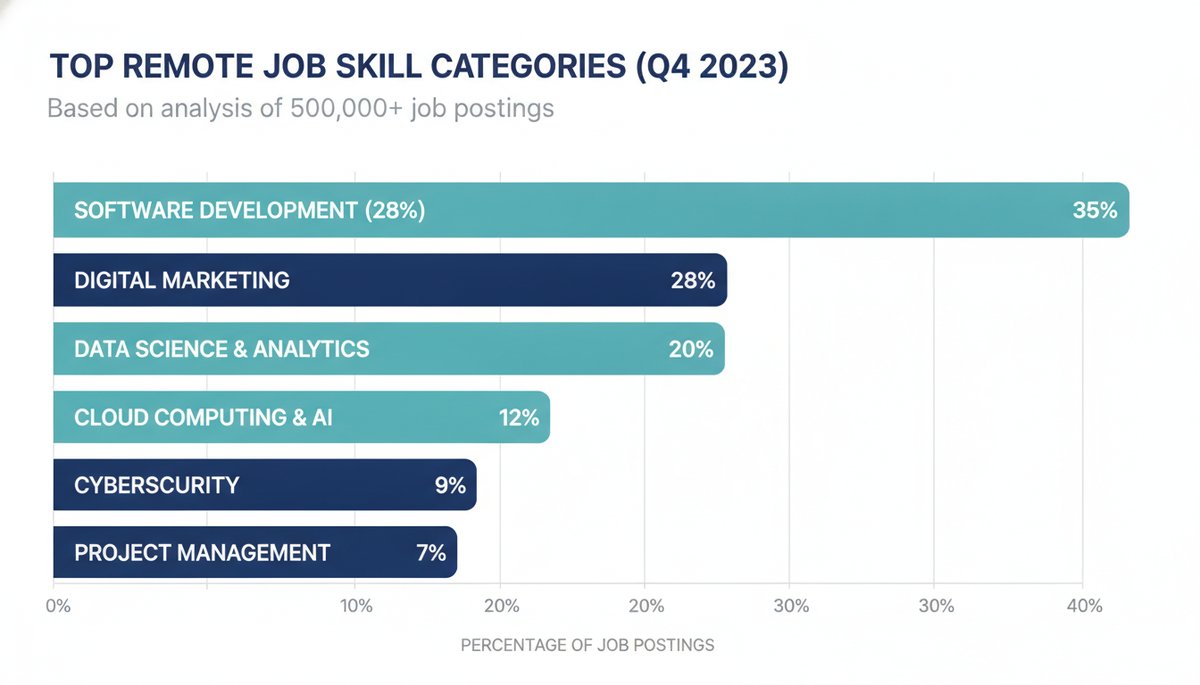
What 2,337 Remote Job Listings Reveal About In-Demand Skills in 2026
The conventional assumption about remote work is that it is primarily a tech story. Learn to code, get into cloud infrastructure, pivot to data science — that is where the remote jobs are.
Our own job board data tells a different story.
Quick Answer: We analyzed 2,337 live remote job listings on our board as of July 2026. The top functions by share of listings are executive and leadership roles (about 31%), customer support (about 27%), marketing (about 24%), and operations (about 22%). Software development appears in about 15% of listings. Remote hiring spans well beyond engineering, about 87% of listings were posted in the last 30 days, and about 13% of roles are open to candidates anywhere in the world.
This is original data from our platform, aggregated from major remote job sources. Not a survey projection. A snapshot of what employers are actively advertising right now.
The broader labor market context supports this picture. According to the U.S. Bureau of Labor Statistics' Current Population Survey, approximately 34.3 million Americans teleworked or worked from home for pay in April 2025 — a 21.6% telework rate. Remote work has stabilized as a structural feature of the U.S. labor market, not a pandemic-era anomaly. Our board captures the active slice of that stable, mature hiring environment.
How We Analyzed 2,337 Live Remote Listings
Methodology: We pulled every live listing from our job board via API on July 10, 2026. The board aggregates postings from major remote-job sources including RemoteOK, Jobicy, WeWorkRemotely, WorkingNomads, and Remotive. We counted 2,337 live listings at the time of the snapshot.
>
Skills and categories come from listing tags. Tags overlap — a single job listing can carry several at once (for example, a role tagged both "marketing" and "content writing" and "senior"). Percentages therefore represent the share of all 2,337 listings tagged with that category, not exclusive slices. They do not sum to 100%.
>
What we do not report: Salary data is populated on only a small fraction of listings and would produce a biased picture, so we have omitted it entirely. The remote/hybrid/onsite classification field is not populated in most listings, so we do not report a work-arrangement split.
Framing the numbers this way matters. When we say "about 27% of listings are tagged customer support," we mean 27% of all 2,337 listings carry that tag — not that customer support accounts for 27% of all remote jobs, or that it beats every other category in isolation. Some listings carry five or six tags simultaneously.
What Skills and Functions Are Actually Hiring?
The table below covers every tag category appearing in at least 10% of our 2,337 listings. Because tags overlap, reading across multiple rows reveals where functions cluster and combine — not a ranked list of mutually exclusive winners.
Skill / Function Tag | Listings | Share of 2,337 |
|---|---|---|
Executive / Leadership | 735 | ~31% |
Customer Support | 634 | ~27% |
Marketing | 565 | ~24% |
Operations | 521 | ~22% |
Digital Nomad-Friendly | 498 | ~21% |
Education / Training | 473 | ~20% |
Medical / Healthcare | 432 | ~19% |
Finance | 414 | ~18% |
Design | 391 | ~17% |
Software Development | 359 | ~15% |
Sales | 332 | ~14% |
Content Writing | 329 | ~14% |
Systems Administration | 319 | ~14% |
Excel / Spreadsheet Skills | 312 | ~13% |
Recruiting | 301 | ~13% |
Travel-Friendly | 295 | ~13% |
Engineering | 261 | ~11% |
Senior-Level | 252 | ~11% |
Video / Multimedia | 245 | ~10% |
HR (general) | 243 | ~10% |
Virtual Assistant | 240 | ~10% |
Two things stand out immediately.
First, the spread is genuinely wide. Customer support, marketing, operations, education, healthcare, finance, design, sales, content writing, and HR all appear in at least 10% of listings. Remote hiring is not concentrated in one or two functions — it is distributed across a large swath of professional work.
Second, software development and engineering, while clearly present, are not the dominant forces. About 15% of listings carry a software development tag and about 11% carry engineering — both figures are smaller than customer support, marketing, operations, education, or healthcare. Understanding job searching in the AI era is valuable in any of these lanes, but the data does not support the narrative that remote hiring is primarily an engineering market.
Is Remote Hiring a Tech Story or a People-Facing Story?
Both are present, but people-facing functions are larger in share than either software development or engineering alone.
To be specific:
About 27% of listings are tagged customer support
About 24% carry a marketing tag
About 22% are tagged operations
About 14% each include sales and content writing
About 13% include recruiting functions
About 10% each cover HR and virtual assistant roles
Compare that to software development at about 15% and engineering at about 11%.
This pattern holds beyond our board. According to Robert Half's Q1 2026 analysis of new job postings, Marketing and Creative roles offer 9% fully remote positions and Technology roles offer 8% — showing that the two domains are remarkably close in remote availability, not separated by the large gap many job seekers assume. Our board's balance between people-facing and technical listings reflects a real equilibrium in the remote market, not a quirk of our aggregation.
This matters for how you position your search. If you have been hesitant to pursue remote work because you lack a CS degree, these numbers are directly relevant. A large share of active remote hiring is in roles that reward communication, coordination, domain expertise, and customer focus — not coding. Our guide to remote jobs you can get without a tech degree maps these accessible lanes in detail.
The "exec" tag deserves a closer look
About 31% of listings carry an executive or leadership tag — the highest share in the dataset. In remote job aggregation, this category is broad: it covers C-level roles, but also senior managers, department heads, team leads, and directors. The consistent signal is that remote employers are actively hiring for leadership and decision-making capacity, not only individual contributors. Mid-career professionals with management experience will find this a real signal worth acting on.
Which Skills Are Accessible Without a Specialized Degree?
Several high-volume tag categories in our dataset are specifically accessible to candidates without a computer science or technical engineering credential.
Virtual assistant roles appear in about 10% of listings. These roles typically require organizational skills, clear written communication, and comfort with standard productivity tools — not technical credentials.
Content writing appears in about 14% of listings. Writing and editing roles have long been among the most location-independent functions in the labor market, and 2026 is no different.
Customer support at about 27% of listings is the most prominent accessible-entry category in our dataset. Entry points exist across industry verticals, and many companies train on their specific platforms and processes.
Excel and spreadsheet skills appear in about 13% of listings — a cross-functional signal indicating demand for structured, data-literate generalists in operations, finance, and administrative functions. This is a learnable, credentialable skill with broad application.
Education and training at about 20% of listings is a substantial and often overlooked category. Remote education and instructional design roles span online tutoring, corporate L&D, e-learning development, and curriculum work — most of which values subject expertise and pedagogy over technical credentials.
If you are building your profile around these accessible lanes, the way you present your skills to ATS and employer screening matters as much as the skills themselves. Knowing how to optimize your resume for ATS in 2026 is especially important in high-volume, competitive categories like customer support and content writing.
Where Are These Remote Jobs Located?
Location data in remote job listings is free-text and inconsistently applied, but the top values in our dataset give a useful directional picture.
Location | Listings | Share of 2,337 |
|---|---|---|
USA | 417 | ~18% |
Anywhere in the World | 315 | ~13% |
UK | 60 | ~3% |
Europe | 51 | ~2% |
Canada | 51 | ~2% |
EMEA | 37 | ~2% |
Germany | 21 | ~1% |
Brazil | 21 | ~1% |
Philippines | 16 | ~1% |
Mexico | 16 | ~1% |
About 18% of listings specify the USA as the target location. For US-based candidates, this is the largest identifiable pool — but not the only option.
About 13% of listings are tagged "Anywhere in the World," meaning the employer has explicitly stated no geographic restriction. That is roughly one in eight live listings on our board that is genuinely borderless.
The UK, Europe, and Canada each appear in 2-3% of listings. These are smaller but consistent presences, particularly for candidates with work authorization in those regions.
Brazil, the Philippines, and Mexico each appear in about 1% of listings. These emerging markets for remote talent reflect a real and growing trend in how global employers build distributed teams.
A note on data quality: a significant share of the 2,337 listings have location data that falls outside these top values, is unlisted, or uses non-standard language. The table above reflects the cleanest, most representative subset. It is directionally useful, not an exhaustive geographic breakdown.
How Fresh Is the Remote Job Market Right Now?
Very fresh — and this is one of the clearest signals in the data.
Of the 2,337 listings in our July 2026 snapshot, about 87% were posted within the last 30 days (2,030 of 2,337). Nearly all listings — 99.9% — were posted within the last 90 days.
This matters practically. One of the persistent frustrations with job boards is outdated listings: applications sent to roles that were filled months ago, or listings that were never real hiring signals at all. Our board, aggregating from multiple live feeds, skews strongly toward active, current openings.
The practical implication: what you see on our board today reflects what employers are actively trying to fill right now. This is consistent with the value of using legit remote job boards that pull from verified, active feeds rather than accumulating stale archives.
What Does the "Digital Nomad" Tag Signal?
About 21% of listings carry a "digital nomad" tag, and about 13% carry a "travel" tag.
These are employer-applied labels indicating the role is explicitly compatible with location independence — and, in many cases, with a traveling or nomadic lifestyle. This is a more specific signal than "remote": it means the employer has indicated they are genuinely open to candidates without a fixed base.
For job seekers who want to work while traveling — not just work from home — this is a meaningful filter. Roughly one in five listings on our board is flagged as travel-compatible by the employer themselves.
Why Competition for Remote Roles Is High — and What That Means for You
Our board data shows strong, active supply. The demand side of the equation is equally striking.
Research by LinkedIn's Economic Graph has consistently found that remote and hybrid roles attract disproportionately more applicants than their share of postings — candidates pursue flexible positions at a far higher rate than their representation in active listings would predict. The gap between worker demand for remote work and employer willingness to offer it is a well-documented structural feature of the current market.
More concretely, Robert Half's Q1 2026 data shows that only 4% of new U.S. job postings are fully remote (with 19% hybrid). Our board, which aggregates exclusively from remote-focused feeds, represents a curated slice of that minority — which is precisely why using a dedicated remote job aggregator matters. Fewer listings, more signal.
The implication for your search strategy: the pool of active remote listings is real but it is more competitive than the overall job market. Standing out requires more than a strong resume. How fast you apply, how well your resume is optimized for ATS screening, and whether you have targeted the right functions for your background all matter more in a high-competition pool. The data in this study helps you answer that last question: which functions have the most volume, and which align with skills you already have.
How to Apply This Data to Your Job Search
Our analysis of 2,337 live remote listings points to several practical implications.
Skill your resume toward the functions that dominate. If your background is in customer support, marketing, operations, finance, education, or healthcare, remote demand in your field is real and substantial. A pivot to engineering is not a prerequisite for entering the remote market.
For non-technical candidates, the data validates accessible entry points. Virtual assistant (about 10%), content writing (about 14%), customer support (about 27%), and Excel/operations skills (about 13%) all appear at significant volumes. These are learnable, credentialable functions with active hiring.
Filter for "Anywhere in the World" if location independence is the goal. About 13% of active listings — roughly 315 openings in our snapshot — explicitly carry that tag. Starting your search with this filter removes the ambiguity of listings that say "remote" but mean "US only."
Prioritize recent listings. With about 87% of listings posted in the last 30 days, you are working with current data. Listings age; competition for fresh postings is lower. Apply quickly to recently posted roles.
Do not assume engineering is the gateway. Customer support, marketing, and operations each outrepresent software development in our snapshot. The remote market has multiple entry points across career stages and educational backgrounds.
Key Takeaways
2,337 live remote listings analyzed from our board, as of July 10, 2026, aggregated from major remote-job sources.
Tags overlap — one listing can carry many categories; percentages are share of listings, not exclusive slices, and do not sum to 100%.
About 31% of listings carry an executive/leadership tag; about 27% customer support; about 24% marketing; about 22% operations.
Software development appears in about 15% of listings; engineering in about 11% — both smaller than customer support or marketing in share.
About 18% of listings specify the USA; about 13% are open to "Anywhere in the World."
About 87% of listings were posted in the last 30 days — the board is overwhelmingly fresh and active.
The board skews toward operations and people-facing functions, not primarily toward engineering or tech.
About 21% of listings carry a "digital nomad" tag, signaling explicit travel compatibility in a meaningful share of openings.
Remote hiring in 2026 is broader than the tech-job narrative suggests. The skills in demand are diverse, the geographic spread is real, and the market is actively hiring right now.
Sources
U.S. Bureau of Labor Statistics — Telework or Work at Home for Pay (Current Population Survey, April 2025) — 21.6% U.S. telework rate (34.3 million workers), April 2025
Robert Half — Remote Work Statistics and Trends (Q1 2026) — breakdown of new job postings by arrangement type and by professional field
Frequently Asked Questions
What remote job skills are most in demand in 2026?
Is remote work mostly tech and engineering jobs?
Where are most remote jobs located in 2026?
How fresh and current are remote job board listings?
Can I get a remote job without a computer science degree?
Related Posts

AI + Careers Briefing — October 13, 2026

AI + Careers Briefing — October 12, 2026