
Court Voids $100,000 H-1B Fee, Reopens Hiring Path
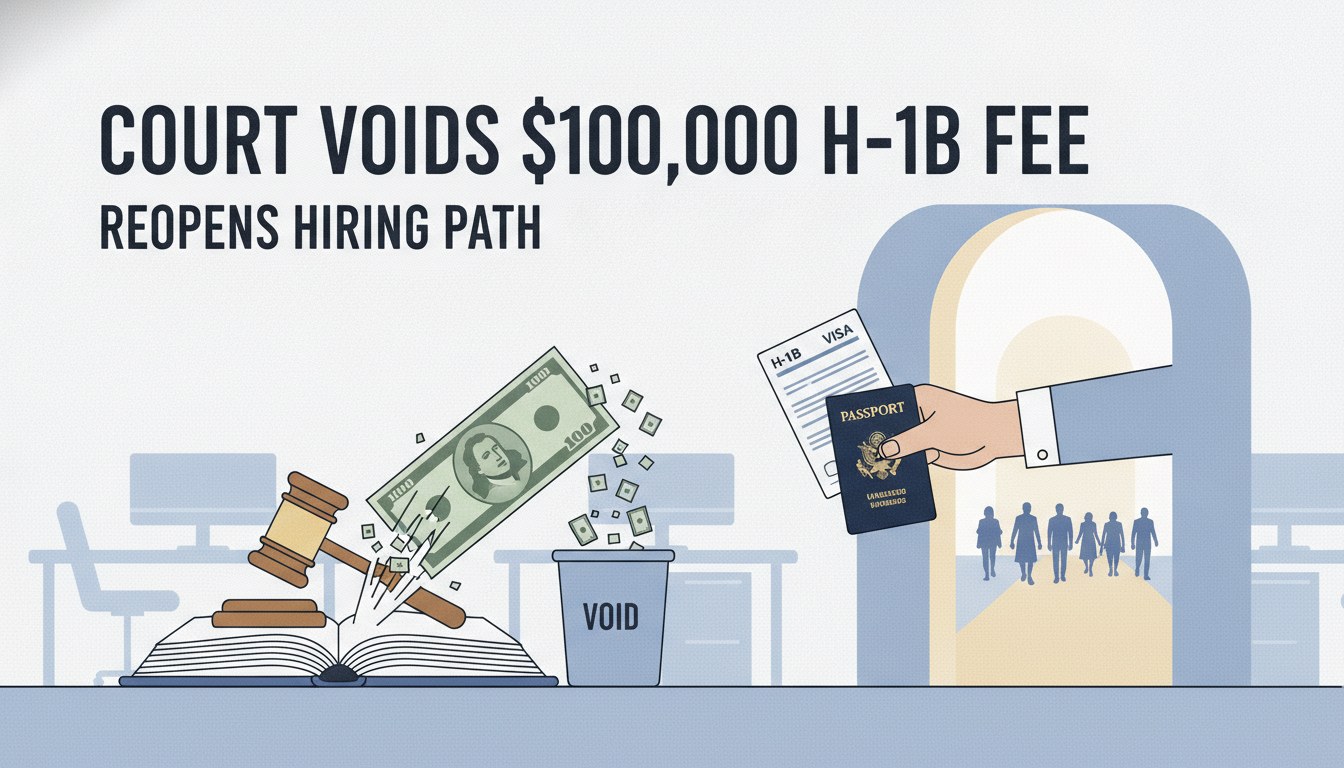
A federal judge on Monday struck down the $100,000 fee the Trump administration imposed on new H-1B visa petitions, ruling that the charge was an unauthorized tax the executive branch had no power to create. U.S. District Judge Leo Sorokin, sitting in Boston, sided with 20 Democratic-led states that sued over the policy, led by California.
In a 42-page decision, Sorokin wrote that "the substance and application of the $100,000 payment reveal that it is a tax, regardless of what the payment is called," and ordered the fee set aside in its entirety. He found the charge was a power that belongs to Congress, not the president.
The fee originated in a presidential proclamation dated Sept. 19, 2025, and took effect days later. It applied only to new H-1B petitions for workers living abroad, not to renewals, and sat on top of standard H-1B filing fees that run roughly $1,700 to $4,500. The H-1B program is capped at 65,000 visas a year, plus 20,000 reserved for applicants with advanced U.S. degrees.
The ruling does not end the fight. An appeal is widely expected, according to legal analysis of the decision, and a separate challenge in federal court in Washington, D.C., where the fee was previously upheld, is also on appeal. Until a higher court weighs in, the legal status of the charge could shift again.
What this means for job seekers
For international workers weighing U.S. roles, the immediate effect is a reopened door. A $100,000 surcharge had made many employers think twice about sponsoring foreign hires, especially for early-career and mid-level positions where the cost dwarfed a year's salary. With the fee vacated, sponsorship math looks more like it did before September, though the pending appeal means nothing is locked in. If you are a candidate, our read is to keep applying to sponsoring employers now while the window is open, and to confirm an offer's timing rather than assume the rule is permanently settled.
For U.S.-based workers competing in the same tech and skilled-labor market, the ruling restores some hiring competition that the fee had blunted. That cuts both ways: more open H-1B pipelines can mean larger applicant pools, but it also signals that employers expect to keep hiring skilled talent at volume. The durable advantage is the same one we point to across the AI-era job search: demonstrable, hard-to-outsource skills and a clear record of shipped work. For anyone targeting remote software engineering roles in 2026, the smarter move is to track which employers are actively sponsoring and hiring, not to bet a job search on any single policy outcome that an appeals court could reverse.
Sources
"Judge voids Trump's $100,000 fee for new H-1B visas" — CBS News — https://www.cbsnews.com/news/judge-trump-100000-h1b-visa-fee-policy-tax/ (accessed 2026-06-09)
"Judge blocks Trump's $100,000 H-1B visa fee" — CNBC — https://www.cnbc.com/2026/06/08/trump-h1b-visa-fee-blocks.html (accessed 2026-06-09)
"Federal Judge in Boston Declares $100,000 H-1B Fee Unlawful" — Tafapolsky & Smith LLP — https://tandslaw.com/federal-judge-in-boston-declares-100000-h-1b-fee-unlawful/ (accessed 2026-06-09)
Related Posts
AI + Careers Briefing — October 13, 2026

AI + Careers Briefing — October 12, 2026