Career Focus 101: How to Stay Productive AND Purposeful in Your First Job
Career Focus 101: How to Stay Productive AND Purposeful in Your First Job
Your first job is supposed to feel exciting. But a few weeks in, many new professionals hit the same wall: a full calendar, a growing task list, and a nagging question — am I even working toward something that matters?
Career focus in your first job isn't just about getting things done. It's about building two distinct skills simultaneously: the ability to do your best work right now, and the clarity to know why that work matters for where you're headed. Most early-career advice covers one or the other. This guide covers both.
By the end of this post, you'll have a practical framework for staying productive without losing your sense of direction — and the tools to build both into your daily habits from day one.
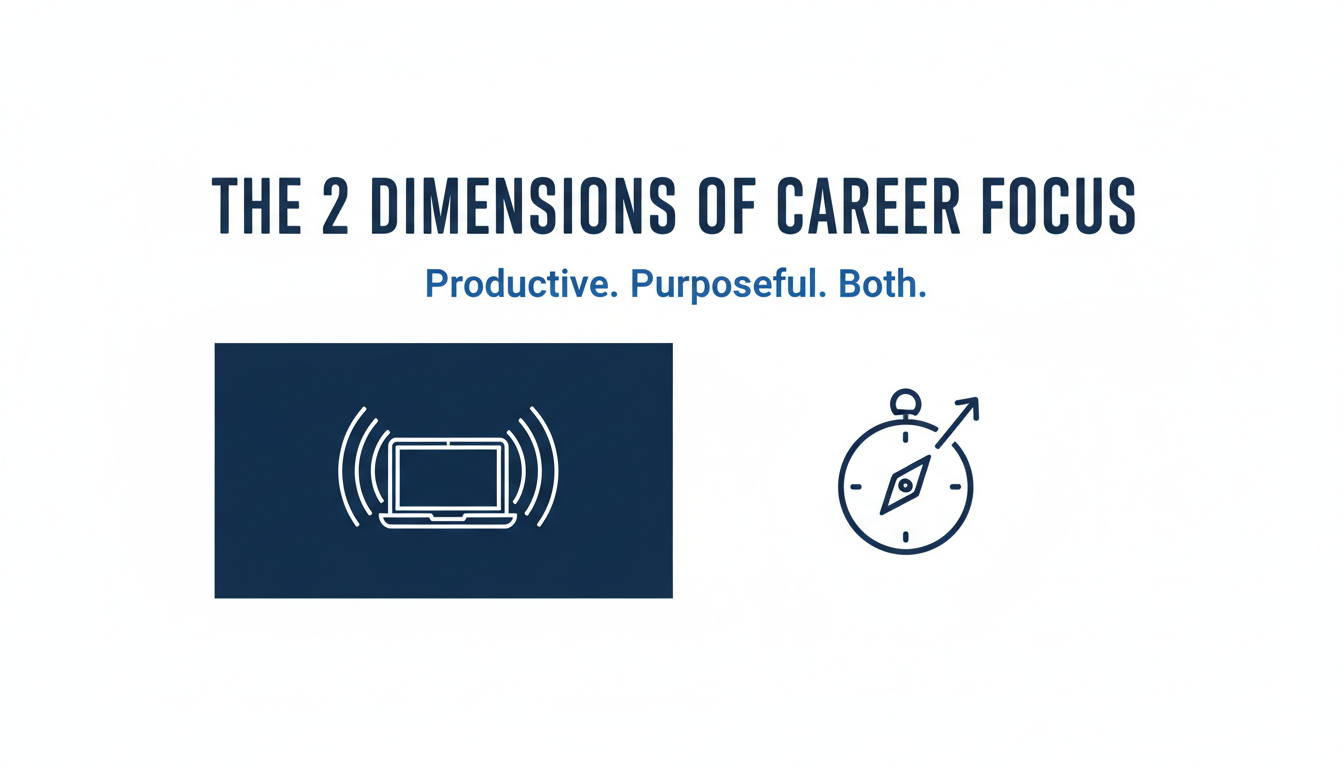
The Two Dimensions of Career Focus
Most people treat "focus" as a single thing. Either you're focused or you're not.
But career focus actually operates on two separate axes — and you need both to build a successful, satisfying career.
Dimension 1: Productivity Focus — The ability to concentrate deeply, manage your energy, and produce high-quality work consistently. This is the "doing well" dimension.
Dimension 2: Direction Focus — The clarity to know which career path you're building toward, what goals you're pursuing, and whether your daily work is actually moving you forward. This is the "moving toward the right destination" dimension.
Think of it this way: productivity focus is the engine. Direction focus is the GPS. A powerful engine without a destination is just burning fuel.
Early-career professionals who succeed long-term almost always master both — but they rarely develop them by accident.
Why First-Job Focus Is Harder Than It Looks
When you're new to a role, your attention is being pulled in more directions than ever before.
You're learning company culture, managing relationships with colleagues and managers, absorbing new tools and processes, and trying to prove your value — all at once. Research from Harvard Business Review consistently shows that context-switching and cognitive overload are among the biggest killers of new employee performance.
Meanwhile, direction pressure comes from another angle. Friends are moving into different industries. LinkedIn updates create a constant low-grade anxiety about whether you're on the "right" path. And nobody hands you a career roadmap on your first day.
The result? Many new professionals spend their first year reactive rather than intentional — responding to urgent tasks but never asking the deeper question: where is all this effort actually taking me?
The good news: both problems are solvable with the right systems.
Dimension 1: Productivity Focus — Doing Your Best Work
The Shallow Work Trap
Most office environments are optimized for the appearance of busyness, not for actual output quality. Meetings, Slack notifications, quick questions, and email threads create constant interruptions that fragment your attention into useless slivers.
Cal Newport, in his influential book Deep Work, defines this fragmented mode as "shallow work" — tasks that are logistically easy, cognitively undemanding, and easy to replicate. The problem isn't that shallow work is bad. It's that most early-career professionals spend nearly their entire day there, mistaking activity for progress.
The antidote is protected focus time. Newport's research demonstrates that the ability to perform deep, focused cognitive work is both increasingly rare and increasingly valuable. For new professionals, developing this skill early creates a compounding advantage.
Build a Focus Routine That Works in an Office
You don't have full control over your environment as a junior employee. But you have more than you think.
Here's a practical system for protecting your concentration:
Time-block your deep work. Identify your peak cognitive hours — most people peak in the morning — and block 60-90 minutes of uninterrupted focus time. Put it in your calendar as a meeting so others see it as occupied.
Batch your shallow tasks. Instead of responding to messages as they arrive, designate two or three specific windows per day for email and chat. This alone can reclaim hours of productive capacity.
Use a daily "Three Priorities" rule. Each morning, write down the three things that, if completed, would make the day a success. Everything else is secondary.
Create environmental triggers. Noise-canceling headphones, a specific playlist, or even moving to a quieter area of the office can signal to your brain that it's time to concentrate.
For a complete system tailored to new professionals, see "Deep Work for Junior Professionals: A Practical System" — which breaks down how to apply Newport's framework in an entry-level context where you have limited autonomy.
Managing Your Energy, Not Just Your Time
Productivity isn't about squeezing more hours out of the day. It's about showing up with full cognitive capacity during the hours that count.
MindTools research on energy management identifies four dimensions of human performance: physical, emotional, mental, and purpose-driven. New professionals who focus only on time management often burn out because they neglect the other three.
Practical habits that protect your energy:
Sleep as a performance tool. Cognitive function drops measurably after less than seven hours of sleep. Treat sleep like a professional obligation.
Move during the workday. A short walk between tasks measurably improves creative thinking and reduces mental fatigue.
Protect lunch. Eating while scrolling or responding to emails extends shallow work into recovery time. A real break restores focus.
Protecting Focus from Digital Distractions
Your phone and browser are not neutral tools. They are engineered by teams of behavioral scientists to capture and hold your attention as long as possible.
For early-career professionals, this creates a particular risk: you're forming the habits right now that will define your work patterns for years. The habits you build in your first job tend to stick.
"The Distraction Trap: How to Protect Your Focus in a World Designed to Steal It" goes deep on how to audit your digital environment and build friction against the platforms that fragment your attention — practical for anyone in an office or remote setting.
Key starting points:
Turn off all non-essential notifications during focus blocks
Use a browser extension to limit social media during work hours
Keep your phone out of your visual field during deep work sessions
Dimension 2: Direction Focus — Moving Toward the Right Career
Why "Just Work Hard" Is Incomplete Advice
Working hard is necessary. It is not sufficient.
Without a clear direction, hard work can carry you deep into a career you never actually chose. Many professionals in their 30s and 40s describe feeling "successful on paper" but disconnected from the work — often because early in their careers, they simply followed the path of least resistance rather than making deliberate choices.
Career focus in your first job means treating direction as a skill to develop, not a box to check once.
The Direction Problem: Too Many Options, Not Enough Data
Early-career professionals face a genuine paradox: you're being asked to choose a direction at the exact moment when you have the least information about what you actually want.
The solution isn't to pick faster. It's to build a structured process for gathering information and making provisional decisions.
"How to Choose a Career Path (And Actually Stick to It)" offers a step-by-step framework for this process — including how to identify what you actually want versus what you've been told you should want.
A few starting questions that accelerate clarity:
What work makes time disappear? Note the tasks and projects where you lose track of time in a good way. These are directional signals.
What skills do you want to be known for in five years? Work backward from that identity rather than just optimizing for the next step.
Who do you want to become? Career direction isn't just about what you do — it's about the professional you're building yourself into.
Career Mindset at the Entry Level: Think Like a Strategist
Most entry-level employees think tactically: complete the assigned task, impress the manager, get the promotion. Strategic thinkers ask a harder question: is this role building the capabilities I'll need to be where I want to be in three to five years?
This shift — from tactical to strategic thinking — is one of the most important early-career mindset upgrades available. And it doesn't require ignoring your day-to-day responsibilities. It just requires layering an additional lens on top of them.
Practical ways to think strategically as a junior professional:
Treat every project as a portfolio piece. Ask yourself what skill you're demonstrating or developing, not just what deliverable you're producing.
Build relationships intentionally. Map the people in your organization who are doing work you find interesting. Find natural opportunities to collaborate or learn from them.
Request stretch assignments. Most managers appreciate proactive junior employees who ask for more responsibility. Frame it as wanting to grow, not wanting to escape your current tasks.
Setting Goals That Actually Guide You
Goal-setting as most people practice it doesn't work. Annual resolutions made in a vacuum, disconnected from daily decisions, have almost no influence on behavior.
Effective career goals have four qualities:
Specific and time-bound — Not "get better at public speaking" but "deliver one internal presentation per quarter for the next 12 months"
Connected to your direction — Each goal should trace back to the professional you're building toward
Reviewed regularly — A goal examined only at year-end isn't guiding anything
Flexible without being abandoned — Plans should update when circumstances change; they should not be discarded at the first obstacle
"How to Set Career Goals That Don't Suck" breaks down a practical quarterly goal-setting system designed specifically for early-career professionals — including how to set goals in the context of a role where your objectives are partly defined by your manager.
Integrating Both Dimensions: A Weekly Practice
Knowing the two dimensions of career focus isn't enough. You need a regular practice that keeps both active.
Here's a simple weekly rhythm that takes under 30 minutes:
Monday — Intention Setting (10 minutes)
Identify your three professional priorities for the week
Review your current career direction goal — does this week's work connect to it?
Block your deep work time on the calendar
Friday — Reflection (15 minutes)
What did you complete? What got pushed?
What did you learn about your own strengths, interests, or energy this week?
One honest question: is the work I'm doing moving me toward where I want to go?
This practice builds what organizational psychologists call metacognitive awareness — the ability to step back from your day-to-day and observe your own patterns. It's a skill that separates good performers from exceptional ones, and it compounds significantly over time.
First Job Success Strategies: The Non-Negotiables
Beyond the two-dimension framework, there are a handful of foundational habits that consistently distinguish early-career professionals who accelerate from those who plateau.
Communicate proactively. Don't wait for check-ins to share progress or flag blockers. Short, clear updates keep you visible and build trust faster than almost anything else.
Learn your industry, not just your job. Read widely. Follow key voices in your field. Attend webinars or industry events. Context makes you more valuable and more interesting in conversations with senior colleagues.
Ask better questions. The smartest-seeming new hires aren't the ones who already know everything. They're the ones who ask precise, curious questions that demonstrate they're thinking. "I want to make sure I understand the real goal here — is it X or Y?" is more impressive than pretending to understand when you don't.
Seek feedback early and often. Don't wait for a formal review. Ask your manager monthly: "What's one thing I could be doing better?" Most managers appreciate the initiative, and you get invaluable data.
Invest in your relationship with your manager. Research from Gallup consistently identifies the manager relationship as the single biggest predictor of employee engagement and retention. Understand their communication style, their priorities, and how they define success for your role.
The Long Game: Career Focus as a Compounding Skill
Career focus in your first job isn't about being perfect. It's about being intentional — slightly more intentional than the average new hire — and doing so consistently enough that small advantages compound into significant ones.
The professionals who look back on their careers with genuine satisfaction rarely credit one big break. They credit habits built early: the practice of deep work, the discipline to reflect regularly, the courage to make deliberate direction choices rather than drifting.
You don't have to have everything figured out. You just have to start building both dimensions — productivity focus and direction focus — from where you are right now.
Your first job is the foundation. Build it deliberately.
Take the Next Step
Choose one action from this post and do it this week — not next month, this week.
If productivity is your immediate challenge, start with the "Three Priorities" rule on Monday morning. If direction feels murky, spend 20 minutes answering the three direction questions in the section above.
Then go deeper. Explore our guide on choosing a career path for a structured approach to direction clarity, or dive into the deep work system for junior professionals to build a concentration practice that fits an entry-level role.
Focus isn't a fixed trait. It's a practice. Start yours today.
Frequently Asked Questions
What is career focus and why does it matter in your first job?
Why is staying focused so difficult when you're starting a new job?
What is shallow work and how does it hurt productivity?
How can I stay productive in an office environment with lots of distractions?
What's the difference between being busy and being productive at work?
Related Posts

AI + Careers Briefing — October 11, 2026

AI + Careers Briefing — October 10, 2026