
AI Trust Gap: How to Read Your Employer's AI Signals Before They Read You Out of a Job
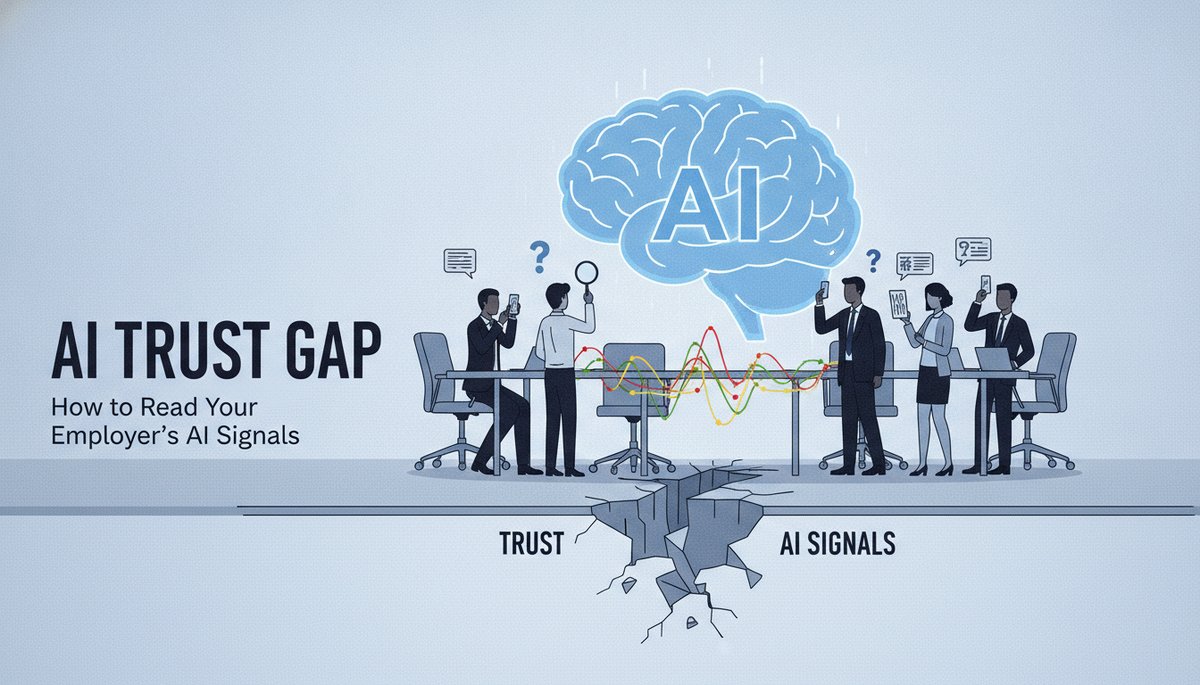
Companies rolling out AI tools are running into a problem that has little to do with the technology itself: their employees don't trust how the rollout is being explained to them. A Businessolver survey cited by Forbes found that just 68% of HR professionals now rate their CEOs as empathetic, a 16-point drop since 2022 and the lowest score since the survey began in 2016. The gap shows up most sharply when AI is involved in the announcement.
Forbes pointed to Microsoft's Xbox division as an example: when Microsoft gaming chief Asha Sharma announced roughly 4,800 company-wide layoffs, including about 3,200 tied to the Xbox division and several studios divested, her memo laid out the strategic rationale clearly but, according to Forbes' reporting, spent little to no time acknowledging the human toll or apologizing to affected staff. General Motors drew similar criticism for running scripted 15-minute HR meetings with no opportunity for employees to ask questions, affecting 500 to 600 workers in Austin, Texas, and Warren, Michigan.
Employees are responding in kind. A survey of 2,400 knowledge workers across the U.S., U.K. and Europe by Writer and Workplace Intelligence, conducted in April 2026 and reported by Fortune, found that 29% of employees admitted to actively sabotaging their company's AI strategy — rising to 44% among Gen Z workers. Tactics included using unauthorized "shadow AI" tools, refusing company-mandated systems, and deliberately producing lower-quality work to make AI look ineffective. Roughly 30% of those saboteurs cited fear that AI would eliminate their job as the primary motivation, and separately, 45% of workers who described themselves as resisting AI cited fear of becoming replaceable. The same survey found only 6% of workers believe their managers accurately understand actual AI usage rates on their teams, and 13% admitted to faking AI use — appearing to rely on the tools while actually completing tasks manually.
What this means for job seekers
If you're evaluating a company or trying to read the room at your current job, the CEO-communication gap Forbes documented is a useful diagnostic. Listen for whether leadership pairs "this positions us for the future" language with any acknowledgment of the human cost — Forbes' reporting suggests that pairing (or the lack of it) is what employees remember, not the layoff numbers themselves.
In interviews, ask direct questions: How is AI changing this role day to day? Who decides which tasks get automated versus handed to a person? Has the team seen layoffs or restructuring tied to AI in the past year, and how was it communicated? Vague or defensive answers are themselves data.
Internally, the Writer/Workplace Intelligence findings point to a clear positioning opportunity: workers who visibly and effectively use AI tools, rather than quietly resisting or faking usage, are the ones least likely to look expendable when a team gets reorganized. Being the person who can explain how you use AI to do more, not the person hiding from it, is a small but real hedge against the anxiety driving the sabotage numbers above.
The bigger signal is trust, not technology. Companies that explain AI changes clearly, acknowledge the disruption honestly, and give employees room to ask questions are the ones least likely to see the shadow-AI and sabotage behaviors documented above take root — and workers evaluating employers can now use that same trust gap as a screening tool of their own.
Sources
Related Posts

AI + Careers Briefing — October 22, 2026

AI + Careers Briefing — October 21, 2026