The AI Opt-Out Moment and What It Means for Your Career
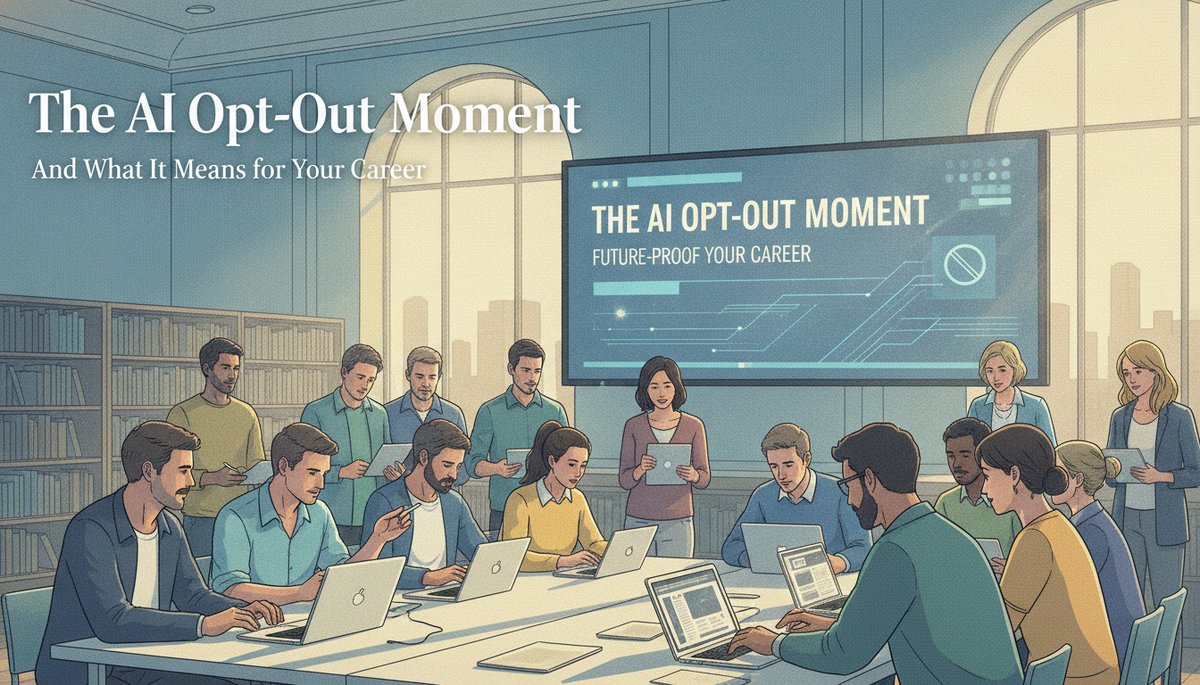
Public librarians across the country are filling waitlists for a new kind of class: workshops explicitly titled "Avoiding AI." Hannah Cyrus, a librarian at Bangor Public Library in Maine, published a journal article describing her approach, then watched as dozens of librarians worldwide reached out to replicate it. Her first two workshops each drew roughly 70 participants — after she cut registration at 30, a Zoom livestream absorbed the overflow. At a public library in South Philadelphia, librarian Charlie Bailey promoted a similar event on Instagram, and the post drew more than 2,000 likes and 220 shares, far outpacing the library's typical engagement. Bailey had to schedule a second session to handle the overflow registrations.
The phenomenon reflects something broader than workshop attendance. TechCrunch reported on July 25 that Bailey was motivated by what he described as people's frustration with AI tools being pushed onto them — a sentiment that maps directly onto workplace data. A Resume Now survey of 1,003 employed U.S. adults found that 63 percent of workers expect AI to make the workplace feel less human in 2026, and 57 percent named over-reliance on AI reducing human skills as the biggest workforce issue of the year — ranking it above job displacement. A separate GoTo "Pulse of Work 2026" survey of 2,500 workers found that 39 percent of all workers say AI reliance has weakened their skill sets, with that figure rising to 46 percent among Generation Z respondents.
The instinct to frame AI fatigue as a culture-war position — techno-optimists versus Luddites — misreads the labor market. Employers are not searching for workers who refuse AI any more than they are searching for workers who outsource all thinking to it. What the hiring data and the library waitlists share is a common signal: discernment is the differentiator now.
What this means for job seekers
The workers drawing the most employer interest right now occupy a specific middle ground: they can use AI tools with genuine fluency, and they can identify when not to. That combination — tool competence plus critical judgment — is harder to demonstrate on a resume than a list of software names, and it is precisely what many candidates lack.
Reviewing job postings and hiring manager commentary, we find that the skills most consistently flagged as undersupplied are not the ones AI threatens first. Communication that reads as authentically human, editorial judgment about when a piece of writing or analysis needs a real perspective rather than a generated one, and the ability to explain your own reasoning without deferring to the model — these are the capabilities that stand out when nearly every other candidate is arriving with an AI-polished application. If you are updating your positioning, our analysis of how to navigate the job search in the AI era offers a practical starting point.
The library workshops are selling out not because people want to delete their AI apps, but because they want to remember what they are capable of without them. That instinct is worth carrying into an interview room. Showing an employer that you have thought carefully about where AI helps and where it substitutes for the judgment they are actually paying for is a stronger signal than any certification. The workers most at risk right now are not the ones who avoided AI — they are the ones who never questioned it.
Sources
Librarians are hosting viral 'Avoiding AI' workshops for people who are fed up with Big Tech — TechCrunch, accessed July 26, 2026
63% of Workers Say AI Will Make the Workplace Feel Less Human in 2026 — PRNewswire / Resume Now, accessed July 26, 2026
Amid heavy AI use, workers say their skills are atrophying — HR Dive, accessed July 26, 2026
Related Posts

AI + Careers Briefing — October 16, 2026

AI + Careers Briefing — October 15, 2026